
FiiO DARKSIDE PRO Compatibility: Voltage & Setup Guide
, к EMiUZEK Editorial Team, 7 мин время чтения
A practical FiiO DARKSIDE PRO compatibility and setup guide. Check 12V/15V requirements, current, connector, polarity and U.S. input voltage before replacing a DAC's included adapter.
Short answer: FiiO lists the DARKSIDE PRO as compatible with several 12V/15V components, including the K11 R2R and K13 R2R. Before connecting any device, match its specified DC voltage, current draw, connector, and polarity; choose the DARKSIDE PRO version whose AC input matches your wall power. It is an optional external power supply, not a DAC upgrade, and FiiO’s specifications do not prove that every listener will hear a change.

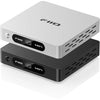
The DARKSIDE PRO is a regulated linear power supply for compatible audio components. Its output is selectable between 12V and 15V DC, with a rated current of up to 3A. The supply uses a 75W toroidal transformer and has a voltage display, a selector, and a DC output cable connection. It replaces a device’s normal external DC adapter only when the device is specified for one of the supported outputs and the electrical connection is correct.
It does not decode music, add headphone output power, or change a DAC’s digital features. It also does not fix an unsuitable cable, a ground loop, a noisy source, or a device that requires a different voltage. Treat it as a power accessory whose first job is safe, compatible operation.
FiiO’s usage guide names the K11, K11 R2R, K13 R2R, K15, K19, R7, R9, TT13, Q7, and the K5 Pro and K7 series. That list is useful when considering a FiiO stack, but still check the exact device’s rear-panel input label and manual. A model name alone does not tell you which power input configuration or cable is needed.
For equipment from another brand, FiiO says the supply can be used when the device accepts 12V or 15V DC and its rated current is within 3A at the selected voltage. That is a screening rule, not permission to guess. The connector, polarity, and required current must also match. If the manufacturer’s documentation is unclear, ask the device maker before connecting it.

Start with the power requirement printed on the DAC, amplifier, streamer, or its original adapter. Select 12V only for a device specified for 12V; select 15V only for a device specified for 15V. Do not choose the higher setting because it seems to provide more performance. A device that expects 12V can be damaged by an incorrect 15V feed.
Check current as well. The connected device must not require more than 3A at the selected voltage. A supply capable of delivering up to 3A does not force 3A into every device; the device draws what its design requires, provided the voltage and connection are suitable.
FiiO’s standard DARKSIDE PRO cable uses a GX16-2 aviation connector at the supply end and a 5.5 × 2.1mm DC plug at the device end, with center-positive polarity. Confirm the powered device uses that exact DC connector and polarity. Other connector sizes can look nearly identical, and reversed polarity can cause damage. Never improvise a cable or rely on the plug fitting physically.
The AC input voltage is a separate check from the 12V/15V DC output. FiiO states that the DARKSIDE PRO’s AC input is not switchable: versions are made for 100–120V or 220–240V mains. A U.S. setup needs the version labeled for 100–120V. Read the rating label on the actual unit before plugging it in; do not assume a DC output selector changes the AC input range.
At the time of this check, EMIUZEK lists an Active DARKSIDE PRO U.S. variant at $152.50 with inventory shown. Prices and inventory can change. Confirm the selected market variant and the AC input marking before purchase and connection.
FiiO says to stop using the supply if its displayed voltage falls more than 5% below nominal, which can indicate overload. Do not open the chassis or attempt internal repairs. If the display is abnormal, the cable heats, or the powered device behaves unexpectedly, switch everything off and contact the manufacturer.

The published specifications describe the power supply; they do not establish an audible improvement in every system. FiiO lists output noise figures of up to 17µV RMS at 12V and 30µV RMS at 15V, A-weighted. Those are power-supply measurements, not a controlled before-and-after measurement of the connected DAC’s audio output.
Owners discussing the DARKSIDE PRO report mixed subjective impressions. Some describe a small change, while others report no clear difference or prefer the device’s original adapter. These are individual listening reports, not controlled engineering evidence. If your current DAC is already quiet and stable, the supplied adapter may be entirely adequate. An external supply is easier to justify when you need a documented compatible replacement, a matching stack, or a specific electrical setup—not because a linear design guarantees better sound.
The DARKSIDE PRO also should not be confused with a 5V USB-C supply for a Raspberry Pi. Our Raspberry Pi linear-supply safety guide covers that different voltage and connection problem.
Consider the DARKSIDE PRO if you own a device on FiiO’s compatibility list, have verified the voltage and cable requirements, and value a single external supply or the coordinated desktop stack. It is also an option for a non-FiiO component only after its manufacturer confirms the voltage, current, connector, and polarity requirements.
Skip it if your original adapter works correctly, you cannot confirm compatibility, your device needs another voltage, or your goal is simply more headphone volume. In that case, compare DAC/amp capability instead. Our FiiO K13 R2R vs K11 R2R comparison explains the real differences between those two compatible DAC/amps. You can also review the FiiO K13 R2R, FiiO K11 R2R, and DARKSIDE PRO listings for current availability before deciding.
Not automatically. Confirm current draw, DC connector, polarity, and the device maker’s approved power requirements as well as the nominal voltage.
Power down and disconnect the equipment before changing the selector. Match the setting to the device’s documented input; do not switch voltage under load.
No. It supplies DC power to a compatible component. It does not change the amplifier’s rated headphone output or make an incompatible headphone easier to drive.
There is no universal guarantee. If the original supply already produces quiet, stable operation, you may hear no change. Treat listening reports as subjective unless supported by controlled, level-matched measurements.