
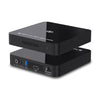
dorpo K3 ST vs BT: Which 8K Media Player Should You Buy?
, к EMiUZEK Editorial Team, 6 мин время чтения
, к EMiUZEK Editorial Team, 6 мин время чтения
A practical dorpo K3 ST vs BT comparison covering Bluetooth, remotes, HDMI, 8K and 4K playback, NAS use, audio connections and which version is worth buying.
The dorpo K3 ST and K3 BT use the same core video platform, memory, storage and wired connections. The real buying decision is whether Bluetooth transmission, Bluetooth reception and the upgraded Bluetooth remote are worth the extra $40. Choose the K3 ST for a fixed rack with an AV receiver and wired network. Choose the K3 BT if you want wireless headphones, phone-to-player audio or a remote that does not depend on direct infrared line of sight.
Both versions use the Amlogic S928X-K platform with 4GB of LPDDR4X memory and 64GB of eMMC storage. They support hardware decoding up to 8K at 60 frames per second and 4K at 120 frames per second, plus Dolby Vision, HDR10+, HDR10 and HLG. The operating interface is FunplayUI 2.0 based on Android 11.
The connections are also the same: HDMI 2.1a, Gigabit Ethernet, dual-band Wi-Fi 6, USB 3.0, USB 2.0, USB-C, optical and coaxial digital audio. Both models can pass Dolby Atmos and DTS:X bitstreams to a compatible receiver or processor and can play local libraries from USB storage or a NAS.

| Feature | K3 ST | K3 BT |
|---|---|---|
| Video and audio decoding | Same | Same |
| Memory and storage | 4GB + 64GB | 4GB + 64GB |
| Bluetooth audio receiver | No | Yes |
| Bluetooth audio transmitter | No | Yes |
| Remote | Infrared | Bluetooth + infrared, backlit learning remote |
| Current EMiUZEK price | $359 | $399 |
The BT model does not add faster video decoding, more storage or higher wired audio quality. Its premium pays for convenience. That keeps the choice simple: if none of the Bluetooth functions solves a real problem in your room, the ST is the better value.
The standard model fits a system in which the K3 connects by HDMI to an AV receiver or processor and by Ethernet to a router or network switch. In that arrangement, the receiver handles speaker output and the television handles the display. Bluetooth adds little because the important signal paths are already wired.
The ST is also sensible when the player remains visible and the infrared remote has a clear path to it. Saving $40 can be more useful than adding a wireless function you will never use. The lower price does not mean reduced decoding performance.
The BT edition can transmit audio to Bluetooth headphones, a soundbar or powered speakers. That is useful for late-night viewing when the main speaker system would disturb other people. Remember that Bluetooth introduces compression and latency, and lip-sync performance depends on both the player and receiving device. A wired HDMI path remains the reference connection for a full theater system.
Bluetooth reception works in the opposite direction: a phone can send music to the K3, which then outputs it to the connected audio system. This can make casual listening easier for guests, although a network service such as Spotify Connect, Tidal Connect, Qobuz or DLNA may provide better control in a stable home network.
The Bluetooth remote is another practical advantage. It does not require the same direct line of sight as a basic infrared remote, so the player can sit inside an open cabinet or away from the television. Its backlight is useful in a dark room, and learning functions can reduce the number of remotes needed for basic commands.
For most owners, no. Native 8K libraries and 8K displays remain less common than 4K systems. The more immediate value of the S928X-K platform is headroom for high-bitrate local files, modern HDR formats and 4K playback at high frame rates. A product can be worthwhile in a 4K theater even if its 8K capability is rarely used.
Before buying for 4K at 120Hz or 8K, verify the complete HDMI chain. The player, cable, AV receiver, switch and display must all support the required resolution, refresh rate and bandwidth. One older component can limit the entire path.
The K3 is designed for owners who keep media on external drives or network storage. It supports common local containers and disc structures, including MKV, Blu-ray ISO and BDMV. Actual menu behavior, subtitle compatibility and Dolby Vision profile support can vary by file and firmware, so a small test library is useful before migrating a large collection.
Use Gigabit Ethernet for high-bitrate remux files whenever practical. Wi-Fi 6 can be fast, but distance, interference and router placement affect sustained throughput. Buffering during a demanding movie does not automatically mean the decoder is underpowered; the storage device or network can be the bottleneck.
The simplest path is K3 HDMI output to an HDMI input on the receiver, then receiver HDMI output to the television or projector. Set audio output to bitstream when you want the receiver to decode Dolby Atmos or DTS:X. If the receiver is not compatible with a format, PCM output may be the safer option.
Optical and coaxial connections are useful for older stereo DACs and amplifiers, but they do not carry every modern surround format. HDMI is the preferred connection for full home-theater audio. Optical or coaxial makes more sense for a two-channel music system.

It does not replace an AV receiver, power amplifier or NAS. The K3 reads and outputs media; another device still powers passive speakers. It can access network storage, but it is not a multi-drive server with redundancy. It also should not be purchased solely as a general Android streaming box without checking whether each desired service is officially supported in your region.
If you need an internal hard-drive bay and a full-width component, compare the K3 with the dorpo UHP-3001 review. The K3 is the smaller and less expensive option for USB and NAS libraries.
Buy the dorpo K3 ST when you have a wired theater, use an AV receiver, and can point an infrared remote at the player. It delivers the same core picture, format and network capabilities for $40 less.
Buy the K3 BT when Bluetooth headphones, phone audio reception or non-line-of-sight remote control will be used regularly. Its value comes from convenience, not a change in decoding quality. That makes the BT premium easy to justify for a shared living room and unnecessary for many dedicated racks.
Availability can vary by country. Browse the verified Media Players collection and contact EMiUZEK to confirm whether the K3 ST or K3 BT can be supplied in your market before ordering.