
FiiO BR15 R2R vs BR13: Which Bluetooth Receiver?
, к EMiUZEK Editorial Team, 7 мин время чтения
Compare the FiiO BR15 R2R and BR13 by Bluetooth, DAC design, outputs, EQ, and price. See which receiver fits your existing stereo and when the upgrade is unnecessary.
If you are choosing between the FiiO BR15 R2R and BR13, the short answer is that the BR13 is the sensible low-cost Bluetooth receiver for a stereo with RCA input, while the BR15 R2R is for a system that can use its broader connections, newer Bluetooth platform, app-based EQ and proprietary R2R conversion. The BR15 is not automatically a better buy for every listener: if you only need to send phone audio to an amplifier, the BR13 already covers that job for much less.

Both devices add Bluetooth reception and digital conversion to an existing system. Pair a phone or tablet, play from a music app, and send the signal to an amplifier or powered speakers. Both also accept selected wired digital sources, so either can serve as more than a Bluetooth adapter.
The BR13 is compact and straightforward. Its FiiO specifications list a QCC5125 Bluetooth platform, an ES9018K2M DAC, stereo RCA analog output, optical input and output, and a coaxial connection that can serve as input or output. It supports Bluetooth codecs including SBC, aptX variants and LDAC. FiiO also lists Bluetooth multipoint and control through the FiiO Control app.
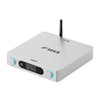
The BR15 R2R is the more ambitious desktop hub. FiiO specifies its own four-channel, fully differential 24-bit R2R DAC and a QCC5181 Bluetooth platform. It adds balanced XLR analog output alongside RCA, plus optical and coaxial digital connections. It also offers a display, remote/app control and a 10-band parametric EQ. Its extra hardware matters only when your system can use it.
| Decision point | BR13 | BR15 R2R |
|---|---|---|
| Best fit | Affordable Bluetooth addition to an RCA stereo | More flexible desktop or rack system |
| Bluetooth platform | QCC5125, Bluetooth 5.2 | QCC5181, Bluetooth 6.0 |
| DAC approach | ESS ES9018K2M | FiiO proprietary 24-bit R2R |
| Analog outputs | RCA | RCA and balanced XLR |
| Digital connections | Optical; coaxial input/output | Optical and coaxial input/output |
| Current US listing | $52.77, 100 units in inventory when checked | Black $199 with 30 in inventory; silver variant out of stock |
Codec support is not a promise of a particular sound quality. The phone and receiver negotiate a codec they both support, and the source app, wireless conditions and downstream system still matter. Both models include LDAC support; the BR15 adds newer platform support and more output flexibility, not a guarantee that every stream will sound different.
Look at the inputs on the amplifier or powered speakers you already own. If they have an available RCA line input and you only want Bluetooth, the BR13’s RCA output is usually enough. Connect red and white RCA cables to a line-level input such as AUX, CD or Line. Do not use a phono input, which is designed for a turntable cartridge and applies different gain and equalization.
The BR15 makes sense when you need balanced XLR into compatible active monitors or a preamplifier, or want to route digital audio to an external DAC over optical or coaxial. Check the receiving device before paying for a connection: an XLR socket is useful only if the rest of the chain supports balanced analog, and digital output requires a downstream DAC.
For most stereo systems, choosing RCA versus XLR is about wiring, level and noise management, not a guaranteed audible upgrade. Balanced cabling can help with long runs or electrically noisy setups; a short, properly working RCA connection is often entirely adequate.
The BR15’s R2R converter is a genuine architectural difference, but architecture alone cannot predict whether you will prefer it. Your amplifier, speakers, room, listening level and personal preference all shape the result. If the BR13 already feeds a capable amplifier cleanly and you are happy with it, replacing it solely because the BR15 uses R2R may be a low-priority upgrade.
The stronger reasons to move up are functional: XLR output, extra digital routing, on-device information, remote control and more extensive EQ options. A parametric EQ can be useful when you know what problem you are correcting, but it is not a substitute for good speaker placement or room treatment. If none of these solves a real limitation in your setup, keep the BR13 and spend elsewhere.

A Bluetooth receiver does not amplify passive speakers by itself. The BR13 and BR15 are sources/converters: their analog line outputs need an integrated amplifier, preamplifier plus power amp, or active speakers. If your system already has a working DAC and a spare analog input, the Bluetooth receiver’s own converter does the work only when you use its analog output. If you instead use optical or coaxial out, the downstream DAC handles conversion.
This distinction can change the value calculation. Suppose your receiver has only RCA inputs and sits close to the amplifier. The BR13 can deliver the core function without paying for balanced outputs you cannot connect. If you own active monitors with XLR inputs, or want to select between USB, Bluetooth and a TV’s optical feed from one desktop unit, the BR15 can simplify the wiring. If your amplifier already has reliable Bluetooth, neither purchase may add enough to justify another box.
The BR15 includes a more extensive parametric EQ workflow than the BR13’s preset/custom EQ options. That can help when you are deliberately correcting a broad tonal imbalance or adapting the system to a known listening position. It is less useful if you do not plan to measure or listen carefully to each adjustment. Keep changes small, save a bypass setting, and compare at matched volume; a louder setting can seem better even when the change itself is not.
The BR15’s proprietary R2R implementation and the BR13’s ESS DAC are objective design differences. They do not establish a universal winner. For a practical upgrade, prioritize whether the BR15 removes a limitation you actually encounter: missing balanced connections, source switching, remote operation, digital routing or a specific EQ need. If those do not apply, the BR13’s lower cost leaves room for better speakers, a subwoofer, or simply keeping the system you already enjoy.
Choose the BR13 if you want a simple Bluetooth receiver for a conventional integrated amplifier, need only RCA analog output, and prefer to keep the budget around the entry-level price. It is also the safer choice if you are not sure you will use EQ, balanced outputs or digital pass-through.
Choose the BR15 R2R if you have balanced inputs, need a digital hub for several sources, want more control from the listening position, or specifically want to try FiiO’s R2R implementation. Before ordering, confirm the exact variant and connection you need: the BR15 listing showed the black model in stock and silver unavailable when checked.
If you are still deciding whether you need fixed or variable DAC output, see our guide to fixed versus variable DAC output. You can also compare the FiiO BR13 with the FiiO BR15 R2R and browse the Bluetooth receiver collection for current options.
The BR13 is the value pick for Bluetooth-to-RCA listening. The BR15 R2R is the more capable choice when its balanced connections, digital routing and control features solve a real system need. Decide from your inputs and intended use first; treat the different DAC architectures as a reason to audition, not as proof that you must upgrade.