
FiiO SNOWSKY DISC Review: Who Is This $99 Player For?
, by EMiUZEK Editorial Team, 6 min reading time
, by EMiUZEK Editorial Team, 6 min reading time
A practical FiiO SNOWSKY DISC review covering offline playback, balanced output, firmware caveats, USB DAC latency, battery life and who should buy this $99 portable player.
The FiiO SNOWSKY DISC makes sense if you want a tiny, inexpensive player for a local music library, balanced wired headphones, and occasional digital-output use. It is less suitable if you expect an Android streaming device, a mature playlist manager, or a zero-latency USB DAC. That distinction matters because the DISC looks simple, but its mix of microSD playback, AirPlay, LDAC, USB audio and coaxial output gives it several possible jobs.
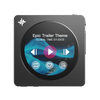
The DISC is a compact Linux-based digital audio player rather than an Android app platform. It stores music on a microSD card of up to 2TB and uses two Cirrus Logic CS43131 DAC chips. FiiO specifies PCM playback up to 32-bit/384kHz, native DSD128, a 3.5mm single-ended output and a 4.4mm balanced output. Its round 1.8-inch touchscreen sits in a 68 × 68 × 12.9mm aluminum body that weighs 77.2g.
At the current EMiUZEK price of $99, the appeal is not only sound quality. It is the ability to leave a phone out of the listening chain, keep an offline library in a pocket, and connect the same player to headphones, a computer or a home DAC.

The strongest use case is an IEM or easy-to-drive headphone owner with a carefully organized local library. The balanced output is rated up to 280mW, giving the player more flexibility than a basic phone dongle, but output power alone does not guarantee a good match with every full-size headphone. Sensitivity, impedance and desired listening level still matter.
It is also useful for listeners who want one inexpensive source that can move between portable and desktop systems. The 3.5mm socket can provide coaxial digital output to an external DAC, while USB-C allows the DISC to work as a computer audio device. AirPlay and LDAC add wireless options, although this is still best understood as a local-file player first.
A smartphone plus USB dongle remains simpler for Spotify, Apple Music, Qobuz and other app-based services. The DISC does not offer the broad app ecosystem of an Android DAP. If your library lives mainly in streaming subscriptions, buying a separate player may add another device without removing much friction.
A phone setup can also be easier for search, playlist editing, podcasts and audiobooks. The DISC is attractive when you want focused offline playback and physical separation from phone notifications, not when you want a miniature general-purpose computer.
If you are still deciding between a dedicated player and a phone-based system, our guide to wired dongle DACs and wireless listening explains the convenience and battery trade-offs.
The 4.4mm connection can provide more available power than the 3.5mm output and may be valuable for headphones that need extra voltage or current. It should not be treated as an automatic sound-quality upgrade. With sensitive IEMs, the single-ended output may already provide enough level and may allow finer volume adjustment.
Use the connection that matches the headphone cable and gives comfortable volume control. Do not add a balanced cable only to chase a specification. The practical benefit appears when the headphone actually needs the additional output capability.
Owner discussions show that firmware behavior matters as much as the hardware. Users have asked about gapless playback, playlist support, ReplayGain, touchscreen response and library scanning. Some reports describe imperfect gaps between tracks or missing playlist features on particular firmware versions. These are software observations, not permanent hardware specifications, and they can change after an update.
Before buying specifically for live albums or classical works, check the current firmware notes and confirm that gapless behavior meets your expectations. Keep music folders clean, remove unrelated files when troubleshooting a scan, and test a smaller card before importing a very large library. Wi-Fi is included for OTA updates, so installing the latest stable firmware should be part of the initial setup.
The DISC supports USB audio and can serve as a desktop DAC, but community reports mention noticeable latency in some computer setups. That may be acceptable for music playback, where timing against a screen is unimportant. It can be distracting for games, video editing or other real-time use.
If low latency is essential, treat USB DAC operation as a feature to test rather than the primary reason to buy. A dedicated desktop DAC or a well-supported USB dongle may be a safer choice. For music-only playback, the DISC can still consolidate a local player and USB audio device in one small unit.

Only in a limited system. AirPlay, LDAC and coaxial output let the DISC feed wireless or digital audio into another component, but it lacks the large-screen control, permanent network connection and broad service integration of a dedicated home streamer. Its strength is portability.
For a desk, it can be a convenient source for an external DAC or powered speakers. For a main listening room, a network streamer will usually be easier to control and integrate. The DISC is better viewed as a portable player that can visit a desktop system than as the center of a whole-home setup.
FiiO rates the 1450mAh battery for up to 12 hours, but real playback time varies with screen use, output connection, volume, file type and wireless activity. Balanced playback at higher levels can consume more power than efficient IEM use. Plan for a shorter result if you keep Wi-Fi or Bluetooth active.
There is no reason to buy a 2TB card immediately. A smaller, reputable microSD card is easier to scan, back up and troubleshoot. Format it as recommended by the manufacturer, organize albums consistently and maintain a second copy of the library. Portable players should never be the only location for irreplaceable music files.
The FiiO SNOWSKY DISC is a compelling $99 option for listeners who want a focused offline player with 3.5mm and 4.4mm outputs, expandable storage and several ways to connect to other audio equipment. Its hardware specification is unusually broad for the price.
Buy it for local albums, IEMs, portable headphones and occasional digital-output use. Skip it if streaming apps, advanced playlists, guaranteed gapless behavior or low-latency computer audio are essential. Those limitations do not make the DISC a poor product; they define the customer it serves.
See the current colors, stock and price on the FiiO SNOWSKY DISC product page, or browse the FiiO collection.