
NOS vs OS on an R2R DAC: What Actually Changes?
, ~에 의해 Kai @ EMiUZEK Team, 7 분 읽기 시간
, ~에 의해 Kai @ EMiUZEK Team, 7 분 읽기 시간
NOS and OS change how an R2R DAC handles PCM before conversion. This guide separates measurable behavior from listening impressions and shows how to choose and compare both modes.
NOS and OS change how an R2R DAC prepares PCM audio before conversion. In NOS mode, the DAC keeps the incoming sample rate at the relevant conversion stage. In OS mode, it creates additional intermediate samples and runs the signal at a higher internal rate. OS usually makes reconstruction filtering easier and improves measured high-frequency accuracy. NOS may sound different, but it is not automatically more accurate, more “analog,” or better.
If your DAC offers both modes, start with OS as the neutral technical baseline, then compare NOS at the same volume.

A 44.1kHz PCM file contains 44,100 samples per second. An oversampling DAC mathematically inserts new samples between the originals before conversion. It does not recover information that was missing from the recording, and it does not turn a CD-quality file into a true high-resolution master. Instead, it changes where unwanted spectral images appear and lets the analog reconstruction filter work farther above the audible band.
A non-oversampling DAC does not perform that internal upsampling step. It converts the original sample sequence at its native rate. That simpler path is the main appeal of NOS, but “less processing” does not mean “less alteration” at the analog output. NOS changes the measurable frequency response and ultrasonic behavior of the complete DAC.
OS mode raises the internal sample rate before the resistor ladder converts the data. On the FiiO K11 R2R and K13 R2R, FiiO specifies global upsampling to 384kHz in OS mode. With the image frequencies moved higher, the DAC can use a gentler analog output filter while maintaining a flatter response near the top of the audible range.
Digital reconstruction filters can have different impulse responses. Some use linear-phase filtering, some minimum-phase filtering, and some roll off earlier than others. Discussions often reduce this to “OS causes pre-ringing,” but that is too broad: ringing behavior depends on the actual filter design. Oversampling itself is a process, not a single sound signature.
NOS mode keeps PCM at its incoming sample rate through the relevant R2R conversion stage. For 44.1kHz material, spectral images sit much closer to the audible band than they do after oversampling. Depending on the DAC’s analog filter, this can produce some treble roll-off and more ultrasonic energy. Those differences are measurable even when the audible result is subtle.
Listeners sometimes describe NOS as smoother, denser, more relaxed, or more natural. Those are subjective impressions, not guaranteed properties. They may be influenced by the DAC’s frequency response, output stage, headphones, speakers, recording, volume matching, or expectation. Other listeners hear little or no difference, which is also normal.
NOS is therefore best understood as an optional presentation, not a hidden “pure” mode that every owner must use.
Technically, OS normally provides the more conventional reconstruction of standard-rate PCM: flatter high-frequency response, images farther from the audible band, and an easier job for the analog filter. That is why OS is a sensible default when accuracy is the priority.
Preference is separate. A small treble change or softer transient presentation may suit a bright headphone, an aggressive master, or a long listening session. A mode can be measurably less accurate and still be preferred by a listener; preference should simply not be rewritten as an engineering fact.
This distinction also prevents confusion with DAC architecture. R2R and delta-sigma describe conversion approaches; NOS and OS describe sample-rate processing. Many modern R2R DACs offer both. For the wider architecture question, read our R2R DAC vs Delta-Sigma guide.
| Your priority | Start with | Why |
|---|---|---|
| Most neutral technical baseline | OS | Usually gives flatter high-frequency response and easier reconstruction filtering. |
| Bright or fatiguing system | Try NOS | Some implementations and listeners report a softer top end, but results vary. |
| Maximum perceived edge definition | Try OS | Some listeners describe transients and treble as clearer in OS. |
| Relaxed long-session listening | Try NOS | A subjective preference that can work well with certain headphones and recordings. |
| You hear no difference | Use either | Small or inaudible differences do not indicate a faulty DAC. |
Do not buy a new DAC only because it has NOS. If your current converter is quiet, transparent, and has the connections you need, headphones, speakers, room acoustics, or amplification may deliver a larger improvement. Our Hi-Fi DAC buyer guide covers those broader priorities.
Software upsampling adds another variable. If a player converts everything to a high sample rate before the DAC receives it, the practical difference between a DAC’s NOS and OS settings may change. Test the DAC with the player at its original sample rate before experimenting with software filters.
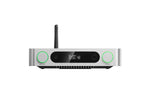
The FiiO K11 R2R is the simpler, compact option. It offers selectable NOS/OS modes, USB-C, optical and coaxial inputs, 6.35mm and 4.4mm headphone outputs, and RCA line/preamp output. FiiO specifies PCM up to 384kHz/32-bit and DSD256 over USB. It does not include Bluetooth, PEQ, or balanced XLR line output.

The FiiO K13 R2R keeps the same basic NOS/OS decision but adds Bluetooth 5.4 reception with LDAC, AAC and SBC, ten-band PEQ, RCA and XLR line outputs, and substantially more balanced headphone power. FiiO also specifies OS upsampling to 384kHz. During native DSD playback, the K13 R2R disables the OS menu setting, so compare modes with PCM.
Both products are currently active and in stock at EMIUZEK. The K11 is the more economical way to explore R2R and NOS/OS; the K13 makes more sense when its stronger amplifier, balanced line output, remote control, Bluetooth, or PEQ solves a real system need. You can also browse the broader DAC & Headphone Amps collection.
No. OS is usually the stronger technical baseline for standard-rate PCM, while NOS offers a different measurable and sometimes audible presentation. Choose NOS because you prefer it, not because it is inherently purer.
No. Forum reports range from obvious preference to no reliable difference. The result depends on the implementation, system, recording, and listener. A subtle or inaudible change is normal.
No new recorded information is created. Oversampling calculates intermediate samples so the conversion and filtering stages can operate at a higher rate. It may change measured behavior and perceived presentation, but it cannot restore detail absent from the source.
Use OS when you want the most conventional, technically neutral starting point. Try NOS when you want to hear how your DAC’s non-oversampling path interacts with your system. Compare at matched volume with PCM, keep the rest of the chain unchanged, and accept “no meaningful difference” as a useful result.
The best setting is not the one with the stronger audiophile story. It is the one that either measures toward your goal or makes your system more enjoyable without creating a problem you did not have.