
-


Fosi Audio Fosi Audio BT30D Pro
Fosi Audio BT30D Pro is a TPA3255-based 2.1-channel Bluetooth integrated amplifier for passive stereo speakers and passive or powered subwoofers. High-output Class-D amplification, separate bass controls and flexible subwoofer connections make it a compact control center for a powerful 2.1 system. Why it stands out High-output 2.1 amplification Dedicated stereo and subwoofer channels provide up to 165 W × 2 plus 350 W maximum at 4 Ω. Flexible subwoofer support Connect a passive subwoofer from the amplified output or powered equipment from the 3.5 mm full-range line output. Independent system tuning Master volume, bass, treble, subwoofer volume and subwoofer frequency controls support practical room integration. Bluetooth and RCA inputs Works with wireless mobile sources or conventional analog line-level equipment. Best for Higher-output compact 2.1 systems Passive bookshelf or floor-standing speakers Passive or powered subwoofer integration Desktop, living-room and small TV systems with analog audio Not ideal for Systems requiring HDMI ARC, optical or USB inputs Users needing a headphone output Turntables without a phono preamplifier EMiUZEK Buying Notes The advertised 165 W × 2 + 350 W figures are maximum ratings at 4 Ω and depend on the power supply and load. The 3.5 mm output is full-range; powered subwoofers should use their own crossover where required. Bluetooth has priority over RCA, so disconnect Bluetooth to return to the wired input. Frequently asked questions Can it power passive speakers and a passive subwoofer? Yes. It provides amplified outputs for both. Can it connect to a powered subwoofer? Yes, using the 3.5 mm full-range output and the powered subwoofer's compatible input. Can it operate as a 2.0 amplifier? Yes. A subwoofer is optional. Does it support aptX? No. The official instructions state that aptX, aptX HD and aptX Low Latency are not supported. Can it connect directly to a turntable? Only if the turntable provides line-level output; otherwise add a phono preamplifier. Can it connect to a TV? Yes when the TV has compatible analog output. It does not have HDMI ARC or optical input. HOW TO CONNECT High-output passive 2.1 system Source icon: streamerSource: Streamer / DAC / phoneConnection: RCA or BluetoothOutput connection: Stereo speaker terminals + passive subwoofer terminalsTarget icon: speakersOutput: Passive speakers + passive subwoofer Powered subwoofer system Source icon: TVSource: TV analog output / DACConnection: RCAOutput connection: Stereo speaker terminals + 3.5 mm full-range outputTarget icon: speakersOutput: Passive speakers + powered subwoofer Passive 2.0 stereo system Source icon: streamerSource: Streamer / DAC / phoneConnection: RCA or BluetoothOutput connection: Stereo speaker terminalsTarget icon: speakersOutput: Two passive speakers Note: A subwoofer is optional; leave the subwoofer outputs unused for a 2.0 system. Technical Specifications Inputs Feature Specification Bluetooth 5.0 Included RCA line input Included Outputs Feature Specification Stereo passive-speaker output Included Passive-subwoofer speaker output Included 3.5 mm full-range line output Included Amplification Feature Specification Amplifier Chip TI TPA3255 Maximum Output 165 W × 2 + 350 W at 4 Ω Speaker Impedance 2–8 Ω Frequency Response 20 Hz–20 kHz (±1 dB) THD ≤0.04% SNR ≥108 dB Input Sensitivity 700 mV Passive Subwoofer Frequency Adjustment up to 300 Hz Connectivity and power Feature Specification Bluetooth Range up to 50 ft without obstacles DC Input Range 12–36 V Power Adapter dependent on selected variant Additional Product Content Comparison: BT30D or BT30D Pro? Feature BT30D BT30D Pro Amplifier architecture 2 × TPA3116D2 TPA3255 Maximum output 50 W × 2 + 100 W 165 W × 2 + 350 W at 4 Ω DC input range Supplied 24 V / 4.5 A 12–36 V Best use Compact moderate-output 2.1 Higher-output 2.1 systems
$170.50 - $204.10
-


Arylic Arylic BR10
Arylic BR10 is a high-quality Bluetooth audio receiver designed to add modern wireless connectivity to traditional HiFi systems, active speakers, and amplifiers. With Bluetooth 5.2, aptX HD and aptX Adaptive support, optical output, analog output, USB audio connection, and USB playback, BR10 allows you to stream music wirelessly from smartphones, tablets, and computers to your existing audio system. Why it stands out Upgrade Traditional Audio Systems BR10 adds Bluetooth playback capability to existing wired audio equipment. Connect smartphones and tablets wirelessly Upgrade traditional amplifiers and active speakers Optical and analog audio outputs Compact plug-and-play design High-Quality Bluetooth Audio BR10 supports advanced Bluetooth codecs for improved wireless sound quality. Bluetooth 5.2 aptX Adaptive aptX HD aptX AAC / SBC Flexible Audio Connections Connect BR10 with different audio systems: Stereo amplifiers Active speakers Sound systems Desktop audio setups Available outputs: Optical digital output 3.5mm analog output USB Audio and Local Playback BR10 provides additional digital audio options. USB DAC connection for PC USB storage playback Local music file playback Best for Upgrading traditional amplifiers with Bluetooth Active speaker systems Desktop audio setups Vintage HiFi systems Users streaming music from smartphones and tablets Not ideal for Users looking for WiFi music streaming Users needing AirPlay or Spotify Connect Users wanting a Bluetooth transmitter for headphones Users requiring built-in speaker amplification EMiUZEK Buying Notes Arylic BR10 is a Bluetooth receiver, not a Bluetooth transmitter. It receives audio from Bluetooth devices and outputs audio to amplifiers or active speakers. Passive speakers require a separate amplifier. Optical output is recommended when connecting to digital audio systems. For sending TV audio to Bluetooth headphones, choose a Bluetooth transmitter instead. FAQ What is Arylic BR10 used for? BR10 adds Bluetooth playback capability to traditional audio systems. Typical setup: Smartphone → BR10 → Amplifier / Active Speakers Can Arylic BR10 connect to an amplifier? Yes. BR10 can connect to amplifiers through analog or optical output, allowing traditional HiFi systems to receive Bluetooth audio. Can Arylic BR10 connect to active speakers? Yes. BR10 can directly connect to compatible active speakers through its analog output. Does Arylic BR10 support high-quality Bluetooth codecs? Yes. BR10 supports aptX Adaptive, aptX HD, aptX, AAC, and SBC codecs with compatible devices. Can Arylic BR10 connect to a computer? Yes. BR10 supports USB DAC connection for computer audio playback. Can Arylic BR10 play music from USB storage? Yes. The USB port supports playback from compatible USB storage devices. Can Arylic BR10 transmit audio to Bluetooth headphones? No. BR10 is a Bluetooth receiver. For transmitting audio to Bluetooth headphones or speakers, use a Bluetooth transmitter. What is the difference between Arylic BR10 and BT10? BR10 is a Bluetooth receiver: Phone → BR10 → Amplifier/Speakers BT10 is a Bluetooth transmitter: TV/Audio Source → BT10 → Bluetooth Headphones/Speakers HOW TO CONNECT Amplifier Setup Source icon: smartphoneSource: Bluetooth DeviceConnection: BluetoothOutput connection: Optical / Analog OutputTarget icon: amplifierOutput: Stereo Amplifier Note: Add Bluetooth streaming to your existing HiFi system. Active Speaker Setup Source icon: smartphoneSource: Bluetooth DeviceConnection: BluetoothOutput connection: Analog OutputTarget icon: speakersOutput: Active Speakers Note: Upgrade wired active speakers with wireless playback. PC Audio Setup Source icon: computerSource: PC / MacConnection: USB DACOutput connection: Audio OutputTarget icon: amplifierOutput: Audio System Note: Use BR10 as a USB Bluetooth audio solution. Technical Specifications Bluetooth Feature Specification Bluetooth Version Bluetooth 5.2 Bluetooth Mode Receiver (RX) Bluetooth Connection Up to 2 Bluetooth Transmitter Devices Codec Support aptX Adaptive / aptX HD / aptX / AAC / SBC Transmission Range Up to 15m Audio Outputs Feature Specification Optical Output Up to 24-bit / 192kHz PCM Analog Output 3.5mm Line Out Audio Inputs Feature Specification Bluetooth Input Supported USB-C USB DAC for PC USB Host USB Storage Playback Analog Input 3.5mm Line In Audio Performance Feature Specification Frequency Response 20Hz–20kHz General Feature Specification Power Input USB-C 5V/1A Dimensions 108 × 72 × 26.6 mm Weight Approx. 89g Recommended System Setup Setup Connection BR10 + Amplifier Smartphone → BR10 → Amplifier → Speakers BR10 + Active Speakers Smartphone → BR10 → Active Speakers BR10 + PC PC → USB → BR10 → Audio System What's in the box Arylic BR10 ×1 USB-C Power Cable ×1 Audio Cable ×1 User Manual ×1 EMIUZEK Download Center Access product manuals, firmware updates, and additional support resources. Arylic BR10 manuals and downloads: https://emiuzek.com/pages/download Additional Product Content Arylic BR10 vs Arylic BT10 Feature Arylic BR10 Arylic BT10 Product Position Bluetooth Receiver Bluetooth Transmitter Main Function Add Bluetooth to audio systems Add Bluetooth output to TVs/audio sources Signal Direction Phone → Audio System Audio Source → Bluetooth Device Bluetooth Mode RX TX Optical Connection Output Input Best Use Upgrade amplifiers and speakers Bluetooth headphones and wireless speakers
$49.90 $45.00
-


Fosi Audio Fosi Audio SK01
Fosi Audio SK01 is a battery-powered analog headphone amplifier and preamplifier with 3.5mm line input, dual headphone jacks and adjustable three-band tone control. Up to 2400mW at 32Ω in high gain, pure bypass, loudness and a 2500mAh battery make it flexible for desktop and transportable wired listening. Why it stands out High-power analog headphone drive High gain delivers up to 2400mW at 32Ω for a broad 16–300Ω headphone range. Three-band tone shaping Separate treble, midrange and bass controls allow more precise adjustment than basic two-band designs. Pure and loudness modes Bypass removes tone processing, while loudness improves perceived bass and treble at low listening levels. Headphone amp and preamp 3.5mm line out feeds an amplifier or powered speakers with the same volume and tone control. Best for Powerful wired headphone listening Analog sources needing portable amplification Users wanting three-band tone control Preamp use with powered speakers or a power amplifier Not ideal for USB digital audio or DAC conversion Bluetooth wireless playback Balanced headphone connections EMiUZEK Buying Notes SK01 is analog only; USB-C is for charging and does not carry audio data. It cannot drive passive speakers directly; line out must feed an amplifier. High gain can become very loud—start at minimum volume before wearing headphones. Frequently asked questions Does USB-C carry audio? No. USB-C is for 5V charging only. Can it work as a preamp? Yes. Use 3.5mm line out into an amplifier or powered speakers. Can it drive passive speakers? No. A separate power amplifier is required. What headphones are supported? Fosi specifies 16–300Ω. Can tone controls be bypassed? Yes. PURE mode bypasses the tone circuit. How long does the battery last? Fosi states up to about six hours, depending on use and load. HOW TO CONNECT Portable headphones Source: Phone, DAP or dongle DACConnection: 3.5mm line inOutput: 3.5mm or 6.35mm headphoneTarget: Wired headphonesNote: USB-C is not an audio input. Desktop preamp Source: DAC or streamerConnection: 3.5mm line inOutput: 3.5mm line outTarget: Power amplifier or powered speakersNote: SK01 controls level and tone. High-impedance headphones Source: Line-level DACConnection: 3.5mm line inOutput: 6.35mm headphoneTarget: 16–300Ω headphonesNote: Choose gain carefully and start low. Technical Specifications Audio performance Feature Specification High / low gain output 2400mW / 300mW at 32Ω Headphone impedance 16–300Ω SNR 108dB THD ≤0.001% at 1kHz / 770mV Frequency response 20Hz–20kHz (±0.05dB) Noise floor / Crosstalk 20μV / 83dB Connections and power Feature Specification Input 3.5mm line in Outputs 3.5mm line out; 3.5mm and 6.35mm headphones Tone adjustment Treble ±8dB; mid ±10dB; bass ±11dB Battery 2500mAh Charging DC 5V USB-C; power only Recommended System Setup Setup Connection Portable Phone/DAP → SK01 → Headphones Desktop DAC → SK01 → Headphones Preamp Source → SK01 line out → Power amplifier Additional Product Content Fosi Audio product comparison Compare the models by the differences that most affect system matching and everyday use. Feature SK01 SK02 P3 Product position Analog headphone amp / preamp USB/optical DAC headphone amp Tube preamp / headphone amp Digital DAC No Yes, ES9038Q2M Bluetooth input only Main inputs 3.5mm line USB, optical Bluetooth, RCA Headphone outputs 3.5mm, 6.35mm 3.5mm, 4.4mm 3.5mm Maximum output at 32Ω 2400mW high gain 755mW via 4.4mm 150mW Balanced headphone output No 4.4mm No Tone controls Treble, mid, bass No Bass, treble Battery operation Yes No No Line / pre-out 3.5mm 3.5mm line / optical RCA, AUX Best use Powerful analog portable amp Hi-res desktop DAC/amp Tube Bluetooth preamp
$100.30
-


Fosi Audio Fosi Audio Q4
Fosi Audio Q4 is a compact desktop DAC and headphone amplifier that converts USB, optical or coaxial digital audio to headphones and RCA analog output. Volume plus bass and treble controls, 24-bit/192kHz S/PDIF decoding and support for 16–200Ω headphones make it a practical entry-level computer or TV audio upgrade. Why it stands out Three digital inputs USB, optical and coaxial connections support computers, TVs, consoles and digital transports. Headphone and RCA outputs Listen through 3.5mm headphones or feed an amplifier and powered speakers through RCA. Direct tone adjustment Front bass and treble controls allow quick system tuning. Compact plug-and-play control Input selection and analog volume are integrated into a small desktop chassis. Best for Entry-level computer audio TV optical PCM to headphones or stereo system Desktop headphones and powered speakers Users wanting physical bass and treble controls Not ideal for Dolby or DTS bitstream decoding Balanced headphone systems Headphones above the specified 200Ω range EMiUZEK Buying Notes Set TVs and consoles to two-channel PCM; Q4 does not decode Dolby or DTS. Inserting headphones can mute the RCA output. USB audio reaches 24-bit/96kHz; optical and coaxial reach 24-bit/192kHz. Frequently asked questions Can Q4 connect to a TV? Yes, through optical or coaxial when the TV is set to PCM stereo. Does it decode Dolby or DTS? No. Use PCM output to avoid noise or silence. Can it drive passive speakers? No. RCA must feed an amplifier, or use powered speakers. Can I use headphones and RCA together? The headphone connection can mute RCA output, so treat them as alternate outputs. Does USB need a driver? It is generally plug-and-play on listed systems; select Fosi Audio Q4 as the playback device. Can I connect an analog source? No. All Q4 inputs are digital. HOW TO CONNECT Computer headphones Source: PC or MacConnection: USB audioOutput: 3.5mm headphoneTarget: 16–200Ω headphonesNote: Select Q4 as the playback device. TV headphones Source: TelevisionConnection: Optical PCMOutput: 3.5mm headphoneTarget: Wired headphonesNote: Disable Dolby and DTS output. Stereo system Source: Computer, TV or transportConnection: USB, optical or coaxialOutput: RCATarget: Amplifier or powered speakersNote: Use Q4 volume and tone controls. Technical Specifications Audio performance Feature Specification USB sampling Up to 24-bit / 96kHz Optical / coaxial Up to 24-bit / 192kHz Headphone output 100mW at 32Ω Headphone impedance 16–200Ω THD / SNR ≤0.01% / ≥105dB RCA output level 2.3V Connections and physical Feature Specification Inputs USB, optical, coaxial Outputs 3.5mm headphone, RCA Chipset SA9023 + CS8412 + 97220 + NE5532 Power 5V Dimensions 73.5 × 98 × 33mm Weight 251g Recommended System Setup Setup Connection Computer headphones Computer → USB → Q4 → Headphones TV system TV optical PCM → Q4 → Amplifier Powered speakers Digital source → Q4 RCA → Powered speakers Additional Product Content Fosi Audio product comparison Compare the models by the differences that most affect system matching and everyday use. Feature Q4 K5 Pro SK02 Product position Entry desktop DAC/amp Gaming DAC/amp Higher-performance desktop DAC/amp USB maximum 24-bit / 96kHz 24-bit / 96kHz 32-bit / 384kHz, DSD256 Other digital inputs Optical, coaxial Optical, coaxial Optical Headphone outputs 3.5mm 3.5mm 3.5mm, 4.4mm Maximum headphone power 100mW at 32Ω 500mW at 32Ω 755mW at 32Ω via 4.4mm Microphone input No Yes No RCA output Yes Yes No Tone controls Bass, treble Bass, treble No Balanced output No No 4.4mm Best use Simple PC/TV audio Gaming with microphone Hi-res desktop headphones
$107.70
-


Fosi Audio Fosi Audio MC101
Fosi Audio MC101 is a compact Bluetooth stereo integrated amplifier for passive speakers, styled with an illuminated analog VU meter. Bluetooth 5.3, RCA input, pre-out, tone controls and up to 100W per channel maximum output combine modern connectivity with tactile vintage-inspired control. Why it stands out Illuminated analog VU meter The moving pointer provides a distinctive visual indication that follows the audio signal. Bluetooth and RCA inputs Switch between Bluetooth 5.3 wireless playback and a conventional analog source. Passive-speaker amplification Dual TPA3116 amplifiers provide up to 100W × 2 maximum at 4Ω. Pre-out system expansion Connect compatible powered equipment or an additional amplifier from the line-level pre-output. Best for Desktop and bookshelf passive speakers Simple Bluetooth stereo systems Users who value physical tone controls Systems needing a pre-output for expansion Not ideal for HDMI ARC, optical or USB sources Headphone listening Turntables without a phono preamplifier EMiUZEK Buying Notes MC101 powers passive speakers; the pre-out is line level and should not be connected to passive speakers. The 100W × 2 figure is a maximum specification at 4Ω and depends on power supply and load. A turntable needs a built-in or separate phono preamplifier before the RCA input. Frequently asked questions Can MC101 power passive speakers? Yes, through its rear speaker binding posts. Does it have a subwoofer output? It has a full-range pre-out; a powered subwoofer must provide a compatible input and crossover. Does it include a phono stage? No. Can it connect to a TV? Only when the TV provides compatible analog output; there is no optical or HDMI input. What Bluetooth codecs are supported? SBC and AAC. Can it drive headphones? No headphone output is provided. HOW TO CONNECT Bluetooth stereo Source icon: phoneSource: Phone / tabletConnection: Bluetooth 5.3Output connection: Speaker terminalsTarget icon: speakersOutput: Passive speakers Wired stereo Source icon: streamerSource: Streamer / DAC / TV analog outputConnection: RCA line inputOutput connection: Speaker terminalsTarget icon: speakersOutput: Passive speakers Expanded system Source icon: streamerSource: Bluetooth or RCA sourceConnection: Bluetooth or RCAOutput connection: Pre-outTarget icon: speakersOutput: Powered subwoofer, powered speakers or downstream amplifier Technical Specifications Connections Feature Specification Inputs Bluetooth 5.3; RCA Outputs Speaker binding posts; pre-out Bluetooth codecs SBC; AAC Bluetooth range ≥10m Amplification Feature Specification Channels 2 Amplifier chipset 2 × TI TPA3116 Maximum output 100W × 2 @ 4Ω SNR ≥100dB THD ≤0.03% Frequency response 20Hz–20kHz (±1.8dB) DC input 12–24V Supplied adapter 24V / 4.5A Additional Product Content Comparison: Which Fosi Audio model is right for you? Model MC101 BT20A BT20A Pro Amplifier Dual TPA3116 Dual TPA3116D2 TPA3255 Maximum stated output 100W × 2 @ 4Ω 100W × 2 300W × 2 @ 4Ω Pre-out Yes No 3.5mm variable pre-out Signature feature Illuminated VU meter Simple compact stereo Higher output and op-amp rolling Best use Vintage-style Bluetooth stereo Entry compact system Expandable higher-output system
$133.10
-


Fosi Audio Fosi Audio DS1
Fosi Audio DS1 is a portable USB DAC and headphone amplifier for phones, tablets and computers. An ESS ES9038Q2M DAC, 3.5mm single-ended and 4.4mm balanced outputs, and high-resolution decoding provide a compact upgrade for wired headphones. Why it stands out ESS ES9038Q2M conversion A proven ESS DAC architecture supports detailed portable playback. Dual headphone outputs Connect conventional 3.5mm headphones or compatible 4.4mm balanced headphones. High-resolution USB audio Supports PCM up to 32-bit/768kHz and native DSD512. Portable source-powered design Runs from the connected USB device without a separate battery or charger. Best for Wired headphone listening from USB-C phones Laptop and desktop USB audio Portable Hi-Res music systems Headphones requiring 3.5mm or 4.4mm output Not ideal for Wireless Bluetooth listening Headsets requiring microphone or inline-control support Driving passive speakers EMiUZEK Buying Notes DS1 has no battery and draws power from the connected source device. Use a compatible OTG adapter or cable for devices without USB-C; Lightning accessories may be required separately. Do not use a 3.5mm-to-4.4mm adapter with the balanced output. Frequently asked questions Does DS1 support both 3.5mm and 4.4mm headphones? Yes, it provides separate 3.5mm single-ended and 4.4mm balanced outputs. Does it include Bluetooth? No. DS1 is a wired USB DAC/headphone amplifier. Does it need charging? No. It is powered by the connected USB source. Can it work with Windows and Mac? Yes. It supports Windows and macOS, subject to the source device and playback software. Can it answer calls through a headset microphone? No. It is intended for audio playback and does not provide headset microphone control. Is warmth during use normal? Some warmth is normal for a compact high-output USB DAC. HOW TO CONNECT USB-C phone listening Source icon: phoneSource: USB-C phone / tabletConnection: USB-C audioOutput connection: 3.5mm headphone outputTarget icon: headphonesOutput: Wired headphones Balanced portable listening Source icon: phoneSource: USB-C phone / playerConnection: USB-C audioOutput connection: 4.4mm balanced outputTarget icon: headphonesOutput: Compatible balanced headphones Computer audio Source icon: computerSource: Windows PC / MacConnection: USB audioOutput connection: 3.5mm or 4.4mm outputTarget icon: headphonesOutput: Wired headphones Technical Specifications Audio architecture Feature Specification Product type Portable USB DAC and headphone amplifier DAC chipset ESS ES9038Q2M Maximum PCM 32-bit / 768kHz DSD DSD64 / 128 / 256 / 512 Outputs and performance Feature Specification Headphone outputs 3.5mm single-ended; 4.4mm balanced Output power 120mW @ 32Ω single-ended; 220mW @ 32Ω balanced Recommended impedance 16–300Ω SNR 120dB Weight 38g Additional Product Content Comparison: Which Fosi Audio model is right for you? Model DS1 DS2 2024 DS3 Primary use Portable Hi-Res music Portable Hi-Res music Music and gaming spatial audio DAC / processing ESS ES9038Q2M Dual CS43131 Hardware 7.1 processing Maximum PCM 32-bit / 768kHz 32-bit / 384kHz 32-bit / 768kHz Maximum DSD DSD512 DSD256 DSD512 Maximum stated output 220mW @ 32Ω balanced 510mW @ 32Ω balanced (manual) 220mW @ 32Ω Best use Compact ESS dongle Higher-power balanced portable setup Gaming effects and spatial audio
$92.60
-


Fosi Audio Fosi Audio P3
Fosi Audio P3 is a compact tube preamplifier and headphone amplifier with RCA and Bluetooth 5.1 source inputs. Replaceable 5654W tubes, aptX-family Bluetooth codecs, bass and treble controls and outputs for headphones, amplifiers and powered speakers make it a versatile analog control stage. Why it stands out Tube preamplifier character A true tube stage adds adjustable tube character between line-level sources and the rest of the audio system. Wireless and wired inputs Bluetooth 5.1 with Qualcomm QCC3031 and RCA input support convenient source switching. Headphone and system outputs A 3.5mm headphone jack, RCA output and AUX output support personal listening and downstream components. Hands-on tone control Front bass and treble controls help adapt sound to headphones, speakers and room conditions. Best for Adding Bluetooth and tube character to a power amplifier Desktop wired headphone listening Active speaker systems needing volume and tone control Users interested in replaceable tube tuning Not ideal for Driving passive speakers directly Turntables without a phono preamp Systems requiring USB, optical or coaxial digital inputs EMiUZEK Buying Notes P3 is a preamplifier/headphone amplifier, not a speaker power amplifier. Its RCA input is line level; a standard turntable needs a phono preamp. RCA and AUX are downstream outputs, while the front 3.5mm jack is for headphones. Frequently asked questions Can P3 drive passive speakers? No. Connect it to a separate power amplifier or powered speakers. Can I use wired headphones? Yes. It supports 16–300Ω headphones through the front 3.5mm output. Does it accept digital inputs? Bluetooth is supported, but there is no USB, optical or coaxial input. Can I connect a turntable? Only through a built-in or external phono preamp before the RCA input. Can I connect an active subwoofer? The AUX or RCA line output can feed compatible downstream equipment; confirm the subwoofer's input and system gain arrangement. Are the tubes replaceable? Yes. The supplied 5654W tubes are replaceable with compatible tube types. HOW TO CONNECT Power amplifier system Source: Streamer, DAC or Bluetooth deviceConnection: RCA or BluetoothOutput: RCA outputTarget: Power amplifier → passive speakersNote: P3 controls source level; the power amplifier drives the speakers. Powered speaker system Source: Phone, streamer or DACConnection: Bluetooth or RCAOutput: RCA or AUX outputTarget: Powered speakersNote: Begin with low volume on both devices. Headphone setup Source: Phone, streamer or DACConnection: Bluetooth or RCAOutput: 3.5mm headphone outputTarget: 16–300Ω wired headphonesNote: Use the front volume and tone controls. Technical Specifications Audio performance Feature Specification Product type Tube preamplifier / headphone amplifier Headphone impedance 16–300Ω Headphone output 250mW at 16Ω; 150mW at 32Ω; 32mW at 250Ω; 20mW at 300Ω Frequency response 20Hz–20kHz (±1dB) SNR ≥103dB THD ≤0.02% Dynamic range 104dB Crosstalk 95dB Connectivity and power Feature Specification Inputs Bluetooth 5.1, RCA Outputs RCA, AUX, 3.5mm headphone Bluetooth chip Qualcomm QCC3031 Bluetooth codecs SBC, AAC, aptX, aptX HD, aptX LL Bluetooth range ≥10m Power input DC 12V / 1.5A–3A Recommended System Setup Setup Connection Stereo preamp Source → P3 → Power amplifier → Passive speakers Active speakers Source → P3 → Powered speakers Headphones Source → P3 → Wired headphones Additional Product Content Fosi Audio product comparison Compare Fosi Audio compact preamplifier and tube DAC options by the capabilities that determine how they fit into a system. Feature P3 P4 GR40 Product position Tube preamp + headphone amp Solid-state analog preamp Tube DAC + headphone amp Analog inputs RCA RCA × 3 None Digital / wireless inputs Bluetooth 5.1 None Bluetooth, USB, optical, coaxial Main outputs RCA, AUX RCA, pre-out RCA Headphone output 3.5mm No 3.5mm Speaker amplification No No No Tube stage Yes, replaceable 5654W No Yes Tone controls Bass and treble Bass and treble with bypass Bass and treble Remote control No Yes No SNR ≥103dB ≥110dB ≥103dB Best use Bluetooth tube preamp and headphones Multiple analog source control Digital sources with tube conversion
$152.70
-


Fosi Audio Fosi Audio HT4S
Fosi Audio HT4S is a compact 4.1/5.0-channel integrated amplifier for multi-speaker, outdoor-audio and simulator systems. Bluetooth, optical and 3.5mm inputs, five amplified channels and a switchable sub/center channel create a flexible multi-speaker system without a full-size AV receiver. Why it stands out Switchable 4.1 or 5.0 operation Configure four main speakers plus a subwoofer channel, or use five full-range speaker channels. Built-in multi-channel power Provides four 30W channels plus a 60W sub channel in 4.1 mode, or five 30W channels in 5.0 mode. Digital and wireless inputs Connect optical PCM, 3.5mm analog or Bluetooth sources. Remote and front-panel control Adjust source, volume, tone and operation without a separate controller. Best for Outdoor and patio multi-speaker systems Sim-racing bass-shaker installations Compact 4.1 or 5.0 speaker systems TV systems with optical PCM output Not ideal for Dolby or DTS surround decoding Systems requiring HDMI ARC Speakers below the specified 4Ω minimum EMiUZEK Buying Notes HT4S is a multi-channel amplifier, not an HDMI adapter or surround-sound decoder. Set the source to PCM stereo when using optical; encoded Dolby/DTS signals are not supported. The SUB/CEN output changes function with the selected mode, so confirm the switch setting before connecting speakers. Frequently asked questions Does HT4S have HDMI? No. Inputs are Bluetooth, optical and 3.5mm AUX. Does it decode Dolby or DTS? No. Use a compatible PCM signal. Can it run five passive speakers? Yes, in 5.0 mode with compatible 4–8Ω speakers. Can it power a passive subwoofer? Yes, in 4.1 mode through the dedicated amplified SUB/CEN channel. Does it have a line output? Yes, a 3.5mm pre-out is provided. Can it be used outdoors? It can power outdoor speakers, but the amplifier itself should remain protected indoors. HOW TO CONNECT Optical TV system Source icon: tvSource: TV / projectorConnection: Optical PCMOutput connection: Speaker terminalsTarget icon: speakersOutput: Four or five passive speakers Outdoor multi-speaker system Source icon: phoneSource: Phone / streamerConnection: Bluetooth or AUXOutput connection: Speaker terminalsTarget icon: speakersOutput: Outdoor passive speakers Sim-racing system Source icon: computerSource: PC / simulator audioConnection: Optical, AUX or BluetoothOutput connection: Speaker and SUB/CEN outputsTarget icon: speakersOutput: Speakers and compatible bass shaker / passive subwoofer Technical Specifications Connections Feature Specification Inputs Bluetooth; optical; 3.5mm AUX Outputs Five speaker channels; 3.5mm pre-out Speaker impedance 4–8Ω Amplification and physical Feature Specification 4.1 rated output 30W × 4 + 60W × 1 @ 4Ω 5.0 rated output 30W × 5 Maximum output 50W × 5 @ 4Ω SNR ≥88dB THD ≤0.03% AC input 110–240V Dimensions 6.1 × 7.2 × 2 in Additional Product Content Comparison: Which Fosi Audio model is right for you? Model HT4S BT30D BT30D Pro System type 4.1 / 5.0 multi-speaker 2.1 stereo Higher-output 2.1 stereo Digital input Optical None None Amplified outputs Up to five channels Stereo + passive subwoofer Stereo + passive subwoofer Maximum stated output 50W × 5 @ 4Ω 50W × 2 + 100W 165W × 2 + 350W @ 4Ω Best use Outdoor, sim racing, multi-speaker Compact moderate-output 2.1 Higher-output 2.1
$197.10
-


Fosi Audio Fosi Audio ZA3
Fosi Audio ZA3 is a balanced Class D power amplifier that operates in stereo or high-power mono mode.Its TPA3255 platform, XLR/TRS and RCA inputs, active-subwoofer output and scalable architecture make it a flexible foundation for compact HiFi systems.Why it stands outFour reasons this product deserves a place in a well-planned audio system.Stereo or Mono OperationUse one ZA3 for a conventional stereo system or two units in mono mode for a scalable dual-mono installation.Balanced XLR/TRS InputThe combo balanced input helps reject interference and integrates with balanced DACs and preamplifiers.Active Subwoofer OutputA dedicated line-level output simplifies adding a powered subwoofer to a stereo system.Replaceable Op-AmpsSocketed op-amps let experienced users experiment with compatible DIP8 dual op-amps.Best for Balanced DAC and preamp systems Stereo passive-speaker systems Dual-mono amplifier upgrades 2.1 systems using a powered subwoofer Installations using 12V trigger control Not ideal for Users expecting Bluetooth, USB or digital inputs Buyers needing a headphone output Passive subwoofers without their own amplifier Buyers who have not checked whether their variant includes a power adapter EMiUZEK Buying Notes ZA3 is a power amplifier and requires an external source or preamp with suitable volume control. The subwoofer output is line level and is only for a powered subwoofer. Check the selected variant: amplifier-only, 32V/5A and 48V/5A power options are listed separately. Frequently Asked QuestionsCan one ZA3 power a stereo pair?Yes. Use stereo mode to power left and right passive speakers from one unit.When are two ZA3 amplifiers required?Use two units when building a dual-mono stereo system, with one amplifier assigned to each channel.Can it connect to an XLR source?Yes. The balanced combo input supports XLR and 1/4-inch TRS connections.Can it power a passive subwoofer?No. Its subwoofer output is line level and requires a powered subwoofer.Does it include Bluetooth or a DAC?No. Connect an external DAC, streamer or preamplifier through RCA or balanced input.Does every option include a power supply?No. Verify the selected product variant before ordering.HOW TO CONNECTBalanced stereo systemSource: Balanced DAC or preampConnection: XLR / 1/4-inch TRSOutput: Speaker terminalsTarget: Passive speaker pairNote: Set ZA3 to stereo mode.Dual-mono systemSource: Balanced DAC or preampConnection: One balanced channel to each ZA3Output: Speaker terminal in mono configurationTarget: One passive speaker per amplifierNote: Use two ZA3 units and set both to mono mode.2.1 stereo systemSource: DAC / preampConnection: RCA or balanced inputOutput: Speaker outputs plus sub-outTarget: Passive speakers and powered subwooferNote: Do not connect a passive subwoofer to sub-out.Technical SpecificationsAmplifier Feature Specification Product Type Stereo/mono Class D power amplifier Amplifier Chip Texas Instruments TPA3255 Speaker Impedance 2–8Ω Modes Stereo / PBTL mono Performance Feature Specification Rated Output with 48V/5A 155W x2 at 4Ω stereo; 235W x1 at 4Ω mono Rated Output with 32V/5A 95W x2 at 4Ω stereo; 110W x1 at 4Ω mono Frequency Response 20Hz–20kHz (±0.1dB) SINAD 89dB SNR ≥106dB THD <0.006% Dynamic Range ≥106dB Connectivity and Power Feature Specification Inputs RCA; XLR / 1/4-inch TRS balanced combo Outputs Passive speakers; active subwoofer line output Trigger 12V trigger input DC Input Range 24–48V Power Options 32V/5A or 48V/5A; variant dependent Recommended System Setup Setup Connection Stereo HiFi DAC/preamp → ZA3 stereo mode → passive speaker pair Dual mono Balanced preamp → two ZA3 units → passive speaker pair 2.1 system Source/preamp → ZA3 → passive speakers + powered subwoofer Additional Product Content Feature ZA3 V3 Mono TB10D Amplifier Format Stereo / mono selectable Monoblock Stereo Amplifier Chip TPA3255 TPA3255 TPA3255 Inputs XLR/TRS, RCA XLR, RCA RCA Stereo from One Unit Yes No Yes Mono Mode Yes Always mono No Active Subwoofer Output Yes No No 12V Trigger Input No No Tone Controls No No Bass, treble Op-Amp Rolling Yes Yes No Best Use Flexible balanced stereo/mono Dedicated monoblocks Simple adjustable stereo
$175.80 - $213.10
-
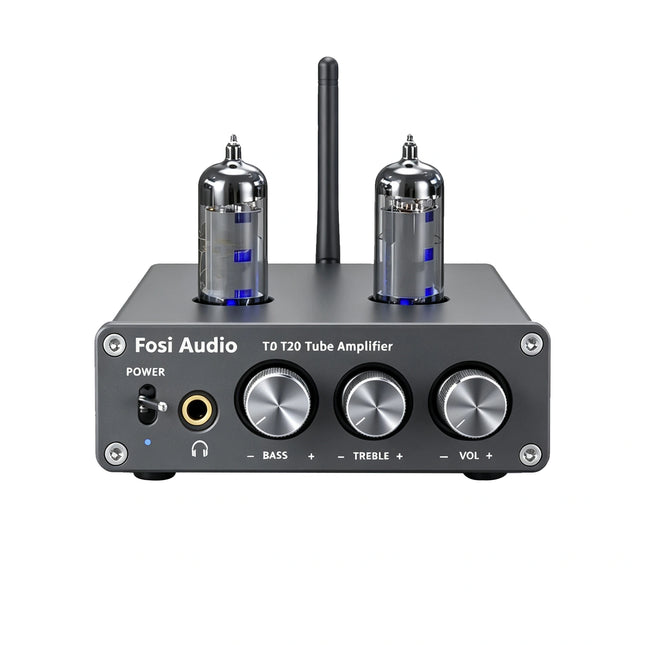

Fosi Audio Fosi Audio T20
Fosi Audio T20 is a compact Bluetooth tube integrated amplifier for passive speakers and wired headphones. It combines 50W x2 Class D speaker power with replaceable vacuum tubes, RCA input and tone controls for a warm, flexible desktop stereo system. Why it stands out Four reasons this product deserves a place in a well-planned audio system. Tube-Buffered Sound Replaceable vacuum tubes add the tube stage and allow compatible tube rolling. Speaker and Headphone Listening The T20 powers passive speakers and also provides a front 3.5mm headphone output. Bluetooth and RCA Inputs Switch between convenient wireless playback and a conventional analog source. Compact Tone Control Independent bass and treble controls make it easier to adapt the system to speakers, headphones and room acoustics. Best for Desktop passive-speaker systems Bluetooth music playback Headphone and speaker listening from one compact amplifier Listeners interested in compatible tube rolling Not ideal for Users requiring optical, USB or HDMI inputs Balanced XLR audio systems Turntables without a built-in or external phono preamp Users needing a dedicated subwoofer output EMiUZEK Buying Notes T20 is an integrated speaker amplifier and can directly drive compatible 4–8Ω passive speakers. Its RCA input is line level; a conventional turntable requires a separate phono preamplifier. The 3.5mm jack is a headphone output, not a microphone connection. Frequently Asked Questions Can the T20 drive passive speakers directly? Yes. Connect a compatible 4–8Ω passive speaker pair to the rear speaker terminals. Can I connect a turntable? Yes only when the turntable has a built-in phono preamp or is used with an external phono preamp. Does it work as a headphone amplifier? Yes, it includes a front 3.5mm headphone output. Does it accept digital audio? No. Inputs are Bluetooth and analog RCA; optical and USB audio are not provided. Can the tubes be replaced? Yes. Use only compatible tube types and power the unit off before replacement. Does it have a subwoofer output? No dedicated subwoofer output is specified. Use a subwoofer integration method supported by your wider system. HOW TO CONNECT Bluetooth speaker system Source: Phone / tabletConnection: BluetoothOutput: Speaker terminalsTarget: Passive speakersNote: Pair the source and set volume low before playback. Wired stereo system Source: DAC / streamer / CD playerConnection: RCA line inputOutput: Speaker terminalsTarget: Passive speakersNote: Use a fixed or controlled line-level source. Headphone listening Source: Phone via Bluetooth or RCA sourceConnection: Bluetooth / RCAOutput: 3.5mm headphone outputTarget: Wired headphonesNote: Lower volume before inserting headphones. Technical Specifications Amplifier Feature Specification Product Type Bluetooth tube integrated amplifier Amplifier Chip TI TPA3116 Maximum Speaker Output 50W x2 at 4Ω Speaker Impedance 4–8Ω Connectivity Feature Specification Inputs Bluetooth 5.0; RCA line input Outputs Passive speaker terminals; 3.5mm headphone Tone Controls Bass and treble Audio Feature Specification Vacuum Tubes Replaceable 6K4 pair Frequency Response 20Hz–20kHz (±1.5dB) THD ≤0.04% SNR ≥99dB Recommended System Setup Setup Connection Wireless stereo Phone → Bluetooth → T20 → passive speakers Wired stereo Streamer/DAC → RCA → T20 → passive speakers Headphones Source → T20 → 3.5mm headphones Additional Product Content Feature T20 T20X P3 Product Position 50W x2 tube integrated amp 100W x2 tube integrated amp Tube preamp / headphone amp Passive Speaker Amplifier Yes Yes No Inputs Bluetooth 5.0, RCA Bluetooth, AUX Bluetooth, RCA Speaker Output 50W x2 max at 4Ω 100W x2 max at 4Ω None Headphone Output 3.5mm 3.5mm 3.5mm Tone Controls Bass, treble Bass, treble Bass, treble Tube Rolling Compatible tubes Compatible tubes Compatible tubes Best Use Compact speaker/headphone system Higher-power speaker system Add tube preamp/headphone stage
$139.50
-


Fosi Audio Fosi Audio T20X
Fosi Audio T20X is a Bluetooth vacuum-tube integrated amplifier for passive speakers and wired headphones.Its upgraded 100W x2 output, replaceable tubes and bass/treble controls create a compact all-in-one amplifier for desktop and bookshelf systems. Why it stands outFour reasons this product deserves a place in a well-planned audio system.100W x2 Maximum OutputThe Class D power stage provides more headroom than the T20 for compatible passive speakers.Replaceable Tube StageTube rolling lets experienced users experiment with compatible tube options.Two Listening OutputsDrive passive speakers or use the 3.5mm headphone connection from the same amplifier.Simple Wireless and Analog PlaybackBluetooth and analog input cover the most common phone, streamer and DAC setups without a complex interface. Best for Bookshelf passive-speaker systems Bluetooth desktop audio Combined speaker and headphone listening Listeners wanting tube character with higher output than the T20 Not ideal for Users requiring optical, USB or HDMI audio Balanced XLR systems Turntables without phono amplification Systems needing a dedicated subwoofer output EMiUZEK Buying Notes T20X is an integrated amplifier and can directly drive compatible 2–8Ω passive speakers. Its analog input is line level; use a phono preamp with a conventional turntable. The maximum output figure depends on speaker impedance, supply voltage and test conditions. Frequently Asked QuestionsCan the T20X drive passive speakers?Yes. It is an integrated amplifier with passive-speaker outputs.Can it connect to a turntable?Yes when the turntable has a built-in phono preamp or an external phono preamp is used.Does it include a headphone output?Yes, a 3.5mm wired headphone output is provided.Does it support optical or USB audio?No. Use Bluetooth or the analog input.Can the vacuum tubes be replaced?Yes. Use compatible tubes and switch the amplifier off before tube replacement.Can I connect an active subwoofer?No dedicated subwoofer output is specified; use a compatible system-level integration method. HOW TO CONNECTBluetooth stereoSource: Phone / tabletConnection: BluetoothOutput: Speaker terminalsTarget: Passive speakersNote: Keep initial volume low when pairing.Wired HiFiSource: Streamer / DAC / CD playerConnection: Analog line inputOutput: Speaker terminalsTarget: Passive speakersNote: Use a line-level source.Headphone systemSource: Bluetooth or analog sourceConnection: Bluetooth / line inputOutput: 3.5mm headphone outputTarget: Wired headphonesNote: Disconnect or lower speaker listening as appropriate. Technical SpecificationsAmplifier Feature Specification Product Type Bluetooth tube integrated amplifier Amplifier Chip TI TPA3221 Maximum Output 100W x2 at 4Ω Speaker Impedance 2–8Ω Audio Feature Specification Frequency Response 20Hz–20kHz (±1dB) THD ≤0.3% SNR ≥86dB Input Sensitivity ≤650mV Connectivity and Power Feature Specification Inputs Bluetooth; analog line input Outputs Passive speaker terminals; 3.5mm headphone Power Supply 24V/4.5A included DC Input Range 12–30V Recommended System Setup Setup Connection Wireless speaker system Phone → Bluetooth → T20X → passive speakers Wired stereo Streamer/DAC → line input → T20X → passive speakers Headphones Source → T20X → 3.5mm headphones Additional Product Content Feature T20X T20 P3 Product Position Higher-power tube integrated amp Compact tube integrated amp Tube preamp / headphone amp Passive Speaker Amplifier Yes Yes No Maximum Speaker Output 100W x2 at 4Ω 50W x2 at 4Ω Not applicable Inputs Bluetooth, line input Bluetooth 5.0, RCA Bluetooth, RCA Headphone Output 3.5mm 3.5mm 3.5mm Tone Controls Bass, treble Bass, treble Bass, treble Tube Rolling Compatible tubes Compatible tubes Compatible tubes Best Use More speaker headroom Compact speaker system Existing amplifier / active speakers
$128.90
-


Fosi Audio Fosi Audio PH05
Fosi Audio PH05 is a one-input, five-output headphone distribution amplifier for sharing one stereo source with up to five listeners. Five independently adjustable 310mW channels, master volume and one-touch mute make it useful for group listening, teaching, podcasting and headphone comparison. Why it stands out Five independent headphone channels Each 3.5mm output has its own level control for different listeners and headphone sensitivities. 310mW per channel All five outputs provide rated power of 310mW at 32Ω for 16–300Ω headphones. Master control and instant mute A large master volume knob and one-touch mute simplify group control. Low-noise distribution design NE5532 amplification, 105dB SNR and 0.001% THD preserve a clean shared signal. Best for Group listening sessions Studio or podcast headphone monitoring Teaching and language labs Comparing several headphones from one source Not ideal for Combining several sources into one output Headsets requiring microphone pass-through Passive speakers or speaker-level amplification EMiUZEK Buying Notes PH05 is one input to five outputs; it cannot work in reverse as a five-input mixer. All outputs are stereo 3.5mm headphone connections and do not carry microphone signals. Set master and channel volumes low before connecting headphones. Frequently asked questions Can it accept five sources? No. PH05 distributes one stereo input to five headphone outputs. Can each listener set a different volume? Yes. Each output has an independent level control. Does it support headset microphones? No. It carries stereo playback audio only. Can it drive passive speakers? No. It is a headphone amplifier, not a speaker power amplifier. What headphones are supported? Fosi specifies 16–300Ω headphones. Can all five outputs be muted together? Yes. Use the one-touch mute function. HOW TO CONNECT Group listening Source: Phone, DAC, mixer or audio interfaceConnection: 3.5mm AUXOutput: Five 3.5mm outputsTarget: Up to five headphonesNote: Start with all channel levels low. Studio monitoring Source: Mixer or audio interfaceConnection: 3.5mm stereo lineOutput: Five headphone outputsTarget: Performers or reviewersNote: Use independent controls for each listener. Headphone comparison Source: Single DAC or playerConnection: 3.5mm AUXOutput: Selected headphone outputsTarget: Multiple headphonesNote: Level-match carefully before comparing. Technical Specifications Audio performance Feature Specification Rated output 310mW × 5 at 32Ω Headphone impedance 16–300Ω SNR / Dynamic range 105dB / 105dB THD 0.001% SINAD / Crosstalk 90dB / 90dB Frequency response 20Hz–20kHz (±0.5dB) Connections and power Feature Specification Input 3.5mm AUX × 1 Outputs 3.5mm headphone × 5 Op-amp TI NE5532 Power DC 12V / 1A Recommended System Setup Setup Connection Group session Source → PH05 → Up to five headphones Studio Audio interface → PH05 → Performers' headphones Comparison DAC → PH05 → Multiple headphones Additional Product Content Fosi Audio product comparison Compare the models by the differences that most affect system matching and everyday use. Feature PH05 PH04 Product position Five-channel headphone distributor Four-channel headphone distributor Inputs 1 × 3.5mm stereo 1 × 3.5mm stereo Headphone outputs 5 × 3.5mm 4 × 3.5mm Independent volume Five channels Four channels Output power 310mW per channel at 32Ω 40mW at 100Ω Supported impedance 16–300Ω Application dependent Master volume Yes Yes One-touch mute Yes No Microphone support No No Best use Five-listener monitoring Basic four-listener distribution
$118.20
-


Fosi Audio Fosi Audio SK02
Fosi Audio SK02 is a compact desktop USB and optical DAC/headphone amplifier with 3.5mm and 4.4mm headphone outputs. An ES9038Q2M DAC, PCM 32-bit/384kHz and DSD256 decoding plus up to 755mW at 32Ω provide a capable all-in-one source for wired headphones and line-output systems. Why it stands out Hi-res desktop DAC ES9038Q2M conversion supports PCM 384kHz and DSD256 over USB. Dual headphone outputs 3.5mm single-ended and 4.4mm outputs support a wider range of headphone cables. Strong 4.4mm drive Up to 755mW at 32Ω provides useful power for many full-size headphones. DAC, headphone amp and pre-out The 3.5mm line output can feed powered speakers or an external amplifier. Best for Desktop wired headphone systems PC and Mac high-resolution audio Users with 4.4mm headphone cables DAC/preamp use with powered speakers or an amplifier Not ideal for Analog source input Bluetooth wireless playback Microphone or gaming-chat input EMiUZEK Buying Notes SK02 accepts USB and optical digital inputs only; it has no analog input. The 4.4mm connection is for headphones; verify cable termination before use. Its 3.5mm output can operate as line out, while optical can also be passed out for a downstream DAC. Frequently asked questions Can I connect an analog source? No. Inputs are USB and optical digital audio. Does it support balanced headphones? It provides a 4.4mm headphone output; use a correctly terminated compatible cable. Can it feed powered speakers? Yes. Use the 3.5mm line output. Can it drive passive speakers? No. Add a power amplifier. What is the USB maximum? PCM 32-bit/384kHz and DSD256 from compatible software and sources. Can it output optical audio? Yes. The shared optical connection supports optical output for compatible downstream equipment. HOW TO CONNECT Computer headphones Source: PC or MacConnection: USB-C audioOutput: 3.5mm or 4.4mm headphoneTarget: 16–300Ω headphonesNote: Select the correct gain and output mode. TV headphones Source: TV or consoleConnection: Optical PCMOutput: Headphone outputTarget: Wired headphonesNote: Set the source to PCM stereo. Powered speakers Source: Computer or optical sourceConnection: USB or opticalOutput: 3.5mm line outTarget: Powered speakers or amplifierNote: Use line-out mode and manage system volume safely. Technical Specifications Audio performance Feature Specification DAC chip ESS ES9038Q2M USB maximum PCM 32-bit / 384kHz; DSD256 Optical maximum 24-bit / 192kHz Headphone impedance 16–300Ω 3.5mm output 190mW at 32Ω 4.4mm output 755mW at 32Ω THD ≤0.001% at 1kHz Connections and physical Feature Specification Inputs USB, optical Outputs 3.5mm headphone, 4.4mm headphone, 3.5mm line out / optical out Frequency response 20Hz–20kHz (±0.02dB) Power 5V USB-C Dimensions 121 × 51 × 43mm Weight 380g Recommended System Setup Setup Connection Computer headphones Computer → USB → SK02 → Headphones TV headphones TV optical PCM → SK02 → Headphones Powered speakers Digital source → SK02 line out → Powered speakers Additional Product Content Fosi Audio product comparison Compare the models by the differences that most affect system matching and everyday use. Feature SK02 SK01 Q4 Product position Hi-res desktop DAC/amp Analog headphone amp/preamp Entry DAC/amp with tone controls DAC chip ES9038Q2M No DAC 97220-based chipset Main inputs USB, optical 3.5mm analog USB, optical, coaxial USB maximum 32-bit / 384kHz, DSD256 No USB audio 24-bit / 96kHz Headphone outputs 3.5mm, 4.4mm 3.5mm, 6.35mm 3.5mm Maximum output at 32Ω 755mW via 4.4mm 2400mW high gain 100mW Analog line output 3.5mm 3.5mm RCA Tone controls No Three-band Bass and treble Battery operation No Yes No Best use Hi-res desktop headphones Powerful analog amplification Simple PC/TV audio
$121.70
-


Fosi Audio Fosi Audio K5 Pro
Fosi Audio K5 Pro is a compact gaming DAC and headphone amplifier with USB, optical and coaxial digital inputs. A microphone input, RCA output, tone controls and strong 3.5mm headphone amplification provide one control point for PC, console and desktop audio. Why it stands out Gaming microphone support A dedicated 3.5mm microphone input supports compatible PC and console communication setups. Three digital source inputs Switch between USB-C, optical and coaxial sources. Powerful headphone output Supports 16–300Ω headphones with up to 500mW at 32Ω. Headphone and speaker integration Use the 3.5mm headphone output or RCA output for powered speakers and amplifiers. Best for PC and console gaming Desktop headphones and powered speakers TVs with optical PCM output Users wanting physical bass and treble controls Not ideal for High-resolution playback above 24-bit/192kHz Balanced headphone connections Passive speakers without a power amplifier EMiUZEK Buying Notes The microphone function works in USB mode and is not available from optical or coaxial inputs. USB playback is limited to 24-bit/96kHz; optical and coaxial support up to 24-bit/192kHz. K5 Pro does not power passive speakers directly; connect RCA to powered speakers or an amplifier. Frequently asked questions Can it be used with PS5? Yes, through a compatible USB connection and system audio settings. Does the microphone work with optical input? No. Microphone support is for USB mode. Can it drive 300Ω headphones? Yes, the official recommended range is 16–300Ω. Can it connect to powered speakers? Yes, through RCA output. Does it support balanced headphones? No. The headphone output is 3.5mm single-ended. Can it decode Dolby or DTS from a TV? Use PCM output; multichannel encoded formats are not supported. HOW TO CONNECT PC gaming Source icon: computerSource: PC / MacConnection: USB-C audio + microphoneOutput connection: 3.5mm headphone outputTarget icon: headphonesOutput: Gaming headset / headphones Console gaming Source icon: deviceSource: Compatible consoleConnection: USB audioOutput connection: 3.5mm headphone outputTarget icon: headphonesOutput: Gaming headset / headphones TV and speaker system Source icon: tvSource: TVConnection: Optical PCMOutput connection: RCA outputTarget icon: speakersOutput: Powered speakers or amplifier Technical Specifications Inputs and outputs Feature Specification Inputs USB-C; optical; coaxial; 3.5mm microphone Outputs 3.5mm headphone; RCA line output Recommended headphone impedance 16–300Ω Digital and headphone performance Feature Specification USB maximum 24-bit / 96kHz Optical/coaxial maximum 24-bit / 192kHz Output power 1000mW @ 16Ω; 500mW @ 32Ω; 300mW @ 64Ω; 150mW @ 128Ω; 80mW @ 300Ω SNR ≥110dB THD ≤0.003% Power input DC 5V via USB-C Additional Product Content Comparison: Which Fosi Audio model is right for you? Model K5 Pro Q4 K7 Primary use Gaming DAC with microphone Simple desktop DAC/headphone amp Premium HiFi and gaming DAC Inputs USB, optical, coaxial, microphone USB, optical, coaxial USB, optical, coaxial, Bluetooth, microphone Headphone output 3.5mm 3.5mm 3.5mm and 4.4mm balanced Maximum USB playback 24-bit / 96kHz 24-bit / 96kHz 32-bit / 384kHz; DSD256 Best use Budget gaming communication Basic music and TV upgrade High-output balanced desktop system
$107.70
-


IEAST iEAST AMP80
iEAST AMP80 is a compact high-power network streaming amplifier that directly drives passive speakers and integrates a powered subwoofer. With 2 × 80W into 4Ω, wired and wireless streaming, Bluetooth, analog and coaxial inputs, it is suited to stronger two-channel and 2.1 systems. Why it stands out 2 × 80W compact speaker power Provides substantially more output than entry-level mini streaming amplifiers. Integrated 2.1 system support Stereo speaker outputs and a dedicated line-level subwoofer output simplify a compact 2.1 setup. Three network and wireless paths Wi-Fi, Ethernet and Bluetooth accommodate convenient or installation-grade connectivity. Useful local source inputs Analog and coaxial inputs add televisions, disc players and other stereo sources. Best for Bookshelf and floorstanding speaker systems 2.1 living-room audio Higher-output multi-room zones TV audio through stereo coaxial output Users replacing separate streamer and amplifier Not ideal for Users requiring HDMI ARC Passive subwoofers Balanced XLR systems Headphone listening Product Details and Connection Views EMiUZEK Buying Notes AMP80 directly drives compatible 4Ω/8Ω passive speakers. Sub out requires a powered subwoofer. For TV connection, use stereo PCM from a compatible coaxial or analog output. Frequently asked questions Can it drive passive speakers? Yes, with 2 × 80W into 4Ω and 2 × 65W into 8Ω under official conditions. Can it connect a subwoofer? Yes, connect an active subwoofer to SUB OUT. Does it have HDMI ARC? No. Does it support Bluetooth? Yes, Bluetooth 5.0 SBC. Can it use Ethernet? Yes, 10/100 Ethernet is supported. Can it connect to a TV? Yes through compatible analog or coaxial stereo PCM output. HOW TO CONNECT Stereo speaker system Source: Streaming servicesConnection: Wi-Fi or EthernetOutput connection: Speaker outputTarget: Passive speakers 2.1 system Source: Network or local sourceConnection: Wi-Fi, Bluetooth, AUX or coaxialOutput connection: Speaker output + sub outTarget: Passive speakers + active subwoofer TV audio system Source: TelevisionConnection: Coaxial PCM or AUXOutput connection: Speaker outputTarget: Passive speakers Technical Specifications Feature Specification Product type Wireless multi-room stereo amplifier Power into 4Ω 2 × 80W at 1% THD+N Power into 8Ω 2 × 65W at 1% THD+N Inputs 2.4GHz Wi-Fi, Bluetooth 5.0, AUX, coaxial Network 10/100 Ethernet Outputs Stereo speaker output; active-subwoofer output DAC ESS9023 Streaming DLNA, AirPlay, Spotify Connect, QPlay SNR 90dB THD+N <0.1% Power 32V/4.75A Dimensions 136 × 134.8 × 40mm Weight 0.32kg Additional Product Content 📊 Comparison: Which iEAST Streaming Amplifier Is Right for You? Choose AMP80 for compact high-output 2.1 audio; choose AMP50 for lower-cost flexible stereo, or eAMP 2 Pro for reference power, dual-band networking and rack integration. Feature AudioCast AMP50 iEAST AMP80 iEAST eAMP 2 Pro Power 2 × 50W/4Ω 2 × 80W/4Ω 2 × 150W/8Ω Subwoofer output No dedicated output Yes Yes Wi-Fi 2.4GHz 2.4GHz Dual-band Wi-Fi 5 Rack/custom control Basic integration TCP/IP/IR 1U, RS232, triggers, IR Best use Flexible compact stereo Powerful compact 2.1 High-end custom installation
$199.00
-


Fosi Audio Fosi Audio DS2
Fosi Audio DS2 (2024) is a portable USB DAC and headphone amplifier for mobile devices and computers. Dual CS43131 DACs, independent volume control and 3.5mm plus 4.4mm outputs deliver clean, powerful wired headphone playback in a compact dongle. Why it stands out Dual CS43131 DAC architecture The current 2024 version uses two Cirrus Logic DAC chips for low-noise conversion. Strong balanced output The 4.4mm output provides substantially more power than the single-ended connection. Independent hardware volume Dedicated buttons allow finer adjustment without relying only on the source device. High-resolution playback Supports PCM up to 32-bit/384kHz and DSD256. Best for USB-C phone and tablet listening Windows and Mac headphone systems Sensitive IEMs and full-size wired headphones Users needing 3.5mm and 4.4mm outputs Not ideal for Bluetooth or wireless headphones Headsets requiring microphone support Users expecting an internal battery EMiUZEK Buying Notes This listing is for the DS2 2024 version with dual CS43131 DACs; older DS2 specifications do not apply. DS2 draws power from the connected source and can feel warm during normal operation. Lightning devices require a compatible Lightning-to-USB-C OTG cable that may be sold separately. Frequently asked questions Which DAC chips are used? The current DS2 2024 uses dual CS43131 DACs. What is the maximum resolution? PCM up to 32-bit/384kHz and DSD256. Does it have a battery? No. It is powered by the connected USB device. Can it drive 4.4mm balanced headphones? Yes, with compatible balanced-wired headphones. Can I use a 3.5mm-to-4.4mm adapter? No. Use headphones terminated correctly for the selected output. Why does it feel warm? A moderate temperature rise is normal during high-resolution or higher-output operation. HOW TO CONNECT USB-C phone listening Source icon: phoneSource: USB-C phone / tabletConnection: USB-C audioOutput connection: 3.5mm outputTarget icon: headphonesOutput: Wired headphones or IEMs Balanced portable listening Source icon: phoneSource: USB-C phone / playerConnection: USB-C audioOutput connection: 4.4mm balanced outputTarget icon: headphonesOutput: Balanced headphones Computer headphone system Source icon: computerSource: Windows PC / MacConnection: USB audioOutput connection: 3.5mm or 4.4mm outputTarget icon: headphonesOutput: Wired headphones Technical Specifications Audio architecture Feature Specification Product type Portable USB DAC and headphone amplifier DAC chipset Dual CS43131 Maximum PCM 32-bit / 384kHz DSD DSD64 / 128 / 256 Outputs and performance Feature Specification Headphone outputs 3.5mm single-ended; 4.4mm balanced Output power 128mW @ 32Ω single-ended; 170mW @ 32Ω balanced Recommended impedance 16–300Ω SNR ≥130dB THD+N <0.0002% Additional Product Content Comparison: Which Fosi Audio model is right for you? Model DS1 DS2 2024 DS3 Primary use Portable Hi-Res music Portable Hi-Res music Music and gaming spatial audio DAC / processing ESS ES9038Q2M Dual CS43131 Hardware 7.1 processing Maximum PCM 32-bit / 768kHz 32-bit / 384kHz 32-bit / 768kHz Maximum DSD DSD512 DSD256 DSD512 Maximum stated output 220mW @ 32Ω balanced 510mW @ 32Ω balanced (manual) 220mW @ 32Ω Best use Compact ESS dongle Higher-power balanced portable setup Gaming effects and spatial audio
$73.40
-


IEAST iEAST M50
iEAST M50 is a compact Wi-Fi, Ethernet and Bluetooth audio receiver for adding wireless playback to an amplifier, DAC or powered speakers.Its ESS9023 DAC and combined analog/optical input and output make it unusually flexible for its size. Why it stands outAnalog and Digital System PathsCombined 3.5mm analog/optical input and output let the M50 work with both legacy and digital HiFi equipment.Stable Wired or Wireless NetworkingChoose 2.4GHz Wi-Fi or 10/100 Ethernet for network playback, with Bluetooth 5.0 for direct wireless input.ESS9023 Analog ConversionThe internal ESS9023 DAC provides a simple analog upgrade path for amplifiers and powered speakers.Compact Multi-Room SourceIts small enclosure adds app-controlled, synchronized playback without replacing the existing audio system. Best for Existing integrated amplifiers Powered speakers External DAC systems Compact multi-room upgrades Not ideal for Users needing passive-speaker amplification Systems requiring dual-band 5GHz Wi-Fi Users requiring AirPlay 2 rather than original AirPlay support EMiUZEK Buying Notes M50 is a source component and cannot directly drive passive speakers. The 3.5mm input and output sockets support analog and optical functions with suitable cables/adapters. The official package lists the power adapter and optical adapter as optional accessories. Frequently asked questionsCan it power passive speakers?No, connect it to an amplifier or powered speakers.Can I use an external DAC?Yes, use the optical output with a compatible adapter/cable.Can it receive audio from a TV?Yes, through analog or optical input when the TV output is compatible.Does it have Ethernet?Yes, it includes 10/100 Ethernet.Does it support 5GHz Wi-Fi?No, the official specification lists 2.4GHz 802.11b/g/n Wi-Fi.Is the power adapter included?The official accessory list identifies the 5V/1A adapter as optional; check the selected store variant. HOW TO CONNECTExisting AmplifierSource: Streaming servicesConnection: Wi-Fi / EthernetOutput: 3.5mm analogTarget: Integrated amplifierExternal DACSource: Network audioConnection: Wi-Fi / EthernetOutput: OpticalTarget: External DAC → amplifierTV DistributionSource: TVConnection: Optical or analog inputOutput: Network multi-room / local outputTarget: Compatible audio system Technical Specifications Feature Specification Product type Wi-Fi and Bluetooth audio receiver DAC ESS9023 Maximum decoding Up to 24-bit/192kHz Wi-Fi 2.4GHz IEEE 802.11b/g/n Ethernet 10/100M Bluetooth Bluetooth 5.0; SBC Inputs Combined 3.5mm analog / optical Outputs Combined 3.5mm analog / optical Power 5V/1A DC Dimensions 86 × 85.4 × 21.5mm Weight 78g Additional Product ContentComparison: Which Compact Streamer Is Right for You?M50 suits mixed analog/digital systems, OLIO adds newer dual-band wireless features, and WiiM Mini offers a polished consumer app ecosystem. Feature iEAST M50 iEAST OLIO WiiM Mini Core buying reason Input/output flexibility Small modern iEAST receiver Simple consumer streaming Wi-Fi 2.4GHz Dual-band Wi-Fi 5 2.4GHz Ethernet Yes No No Digital input Optical No No Digital output Optical Optical Optical Best use Mixed source/receiver system Small dual-band upgrade Entry consumer streamer
$199.00 $79.90
-


Fiio FiiO BR13
The FiiO BR13 is a compact Bluetooth receiver, USB DAC and S/PDIF converter designed to add modern wireless and digital connectivity to an existing amplifier, receiver or active-speaker system. It receives audio through Bluetooth, USB-C, optical or coaxial input and outputs through stereo RCA, optical or coaxial connections. A Qualcomm QCC5125 Bluetooth platform supports LDAC and multiple aptX codecs, while the ES9018K2M DAC and TPA1882 op-amp provide a standard 2Vrms RCA line output. The BR13 is a source component only: it has no headphone amplifier, speaker amplifier, battery or network-streaming platform. Why it stands out LDAC and aptX Adaptive Bluetooth reception Bluetooth supports LDAC, aptX Adaptive, aptX HD, aptX Low Latency, aptX and SBC from compatible phones, tablets and computers. Bluetooth, USB DAC and S/PDIF conversion Use one small component for wireless reception, computer audio, television audio and conversion between optical, coaxial and analog RCA systems. ES9018K2M DAC with 2Vrms RCA output The internal ESS DAC and TPA1882 analog stage allow direct connection to a line-level amplifier input or active speakers without requiring a separate DAC. App control, PEQ and digital routing tools FiiO Control provides Bluetooth codec settings, presets, custom PEQ, channel balance, upsampling, low-latency mode and OTA firmware updates. Best for Adding high-resolution Bluetooth reception to an older amplifier or active speakers Converting television optical or coaxial audio to RCA line output Using a computer or compatible console with a simple UAC1.0 USB DAC Routing optical and coaxial digital signals between existing audio components Not ideal for Users who need Bluetooth transmission to wireless headphones Anyone who wants Wi-Fi, AirPlay, Roon Ready or native streaming-service support Driving headphones, passive speakers or a power amplifier that requires balanced input Portable use without a continuous USB power source EMiUZEK Buying Notes The BR13 is a Bluetooth receiver, not a transmitter. It accepts audio from a phone or computer and sends it to wired audio equipment. RCA is a 2Vrms line-level output with digital volume adjustment, not a powered headphone or speaker output. A downstream amplifier or active speakers are required. FiiO Control connects only while the BR13 is in Bluetooth input mode. Saved settings such as upsampling can remain active after switching inputs, but EQ works only with Bluetooth and USB input. Digital upsampling can prevent sound from some optical or coaxial devices. If a digital output is silent or incompatible, disable upsampling or enable the appropriate compatibility setting. Frequently asked questions Can the FiiO BR13 transmit Bluetooth audio? No. It receives Bluetooth audio from a phone, tablet, television or computer. It cannot send audio to Bluetooth headphones or wireless speakers. Does the BR13 support Wi-Fi streaming? No. It has no Wi-Fi, AirPlay, Chromecast, Spotify Connect or Roon Ready function. Use Bluetooth, USB, optical or coaxial input. Can I connect headphones directly? No. It has no headphone socket or headphone amplifier. Connect RCA output to a separate headphone amplifier. Can it drive passive speakers? No. Connect it to an integrated amplifier, receiver, power amplifier with suitable input sensitivity or active speakers. Which Bluetooth codecs are supported? It supports SBC, aptX, aptX LL, aptX HD, aptX Adaptive and LDAC. Codec availability depends on the transmitting device and enabled settings. Does it support AAC? AAC is not included in FiiO's official BR13 codec list. Apple devices can connect using a mutually supported codec, normally SBC. Can two phones stay connected simultaneously? Yes. Bluetooth multipoint supports two transmitting devices. Pause playback on one before starting the other. What is the maximum Bluetooth range? FiiO states a transmission distance of up to approximately 30 metres under favourable open conditions. Walls, interference and the source device can reduce the practical range. What does low-latency mode do? It prioritizes aptX Low Latency where the transmitter also supports it, reducing delay for video and gaming. Both ends must support the codec for the benefit to apply. Can I use it as a USB DAC? Yes. USB-C supports UAC1.0 plug-and-play operation up to PCM 96kHz/24-bit with compatible computers, phones, PS5 and Nintendo Switch systems. Does the USB-C port carry both power and audio? Yes. It is a two-way USB-C power/data connection. The BR13 has no battery and requires a stable 5V/1A USB supply during operation. What are the maximum optical and coaxial input rates? Coaxial input supports up to PCM 192kHz/24-bit, while optical input supports up to PCM 96kHz/24-bit. What are the maximum digital output rates? Optical and coaxial output support up to PCM 96kHz/24-bit when using the BR13's frequency-doubling or conversion functions. Can it convert optical input to RCA output? Yes. Optical input can be decoded to RCA and can also be routed to optical or coaxial digital output. Can it convert coaxial input to optical output? Yes. In Coaxial In mode, the BR13 can provide optical and RCA output. What is optical bypass? In Optical In mode, the optical signal can pass through to Optical Out while the BR13 also supports other compatible outputs, simplifying systems that share one optical source. Can optical and coaxial outputs work simultaneously? Output availability depends on the selected input and routing mode. Optical input can provide coaxial, optical and RCA output; coaxial input provides optical and RCA output. Why is there no sound from optical or coaxial output? Confirm that the source uses supported stereo PCM, select the correct input and disable digital upsampling in FiiO Control if the receiving device cannot accept the converted rate. Does PEQ work with optical and coaxial input? No. FiiO specifies EQ support only for Bluetooth and USB input. Other saved system settings may still affect S/PDIF modes. Does upsampling improve every source? Upsampling changes the output sample rate but cannot recreate information absent from the source. Its audible benefit is system-dependent and compatibility should take priority. Can the BR13 control active-speaker volume? Yes, its 60-step digital volume can adjust RCA output. Begin at a low level, especially when connecting directly to active speakers. Is the BR13 the same kind of product as the FiiO SR11? No. BR13 focuses on Bluetooth reception, USB DAC and S/PDIF conversion with analog RCA output. SR11 is a Wi-Fi/Ethernet digital streaming transport with Roon Ready and AirPlay but no analog output. HOW TO CONNECT Phone to an existing amplifier Source icon: PhoneSource: Smartphone / tabletConnection: BluetoothOutput connection: Stereo RCA line outputTarget icon: AmplifierOutput: AUX / LINE / CD input on an amplifier or receiver Note: Select Bluetooth input, pair the phone and begin with low system volume. Bluetooth is received by the BR13 and output through wired RCA. Television to active speakers Source icon: TVSource: Television optical outputConnection: TOSLINK optical inputOutput connection: Stereo RCA line outputTarget icon: Active speakersOutput: Powered-speaker RCA input Note: Set the television to compatible stereo PCM. If there is no sound, disable BR13 digital upsampling and recheck the TV format. Computer USB DAC Source icon: ComputerSource: PC / Mac / compatible consoleConnection: USB-C UAC1.0Output connection: Stereo RCA line outputTarget icon: Audio systemOutput: Amplifier, receiver or active speakers Note: Select USB input and choose BR13 as the source device's audio output; USB supports up to PCM 96kHz/24-bit. S/PDIF format conversion Source icon: Digital sourceSource: TV / set-top box / disc playerConnection: Optical or coaxial inputOutput connection: Optical, coaxial or RCA according to input modeTarget icon: DAC or audio systemOutput: Compatible external DAC, amplifier or active speakers Note: Coaxial input can output optical and RCA; optical input can output optical, coaxial and RCA. Match the sample-rate capability of the receiving device. Technical Specifications Feature Specification Product type Bluetooth receiver, USB DAC and S/PDIF converter DAC / op-amp ESS ES9018K2M / TPA1882 Bluetooth chipset Qualcomm QCC5125 Bluetooth Receive-only; multipoint supported Bluetooth codecs SBC, aptX, aptX LL, aptX HD, aptX Adaptive, LDAC Inputs Bluetooth, USB-C, optical, coaxial Outputs Stereo RCA, optical, coaxial USB DAC UAC1.0; up to PCM 96kHz/24-bit Coaxial input Up to PCM 192kHz/24-bit Optical input Up to PCM 96kHz/24-bit Optical / coaxial output Up to PCM 96kHz/24-bit RCA output 2Vrms; 60-step digital volume EQ Preset EQ plus two 10-band custom PEQ profiles; Bluetooth and USB input only Display 1.1-inch LCD Control Front buttons and FiiO Control app Firmware OTA update through FiiO Control Power USB-C 5V/1A; no battery Dimensions Approx. 98 × 96 × 26.5mm Weight Approx. 135g Color Black What's in the box, manuals and downloads FiiO BR13 ×1 USB-A to USB-C Data/Power Cable ×1 User Manual ×1 Warranty Card ×1 Visit the EMiUZEK download center. Additional Product Content FiiO BR13 vs SR11 Feature BR13 SR11 Main purpose Bluetooth receiver, USB DAC and S/PDIF converter Wi-Fi/Ethernet digital streaming transport Network streaming No Roon Ready and AirPlay Bluetooth reception Yes, including LDAC Yes with supported firmware Analog RCA output Yes, 2Vrms No Digital outputs Optical and coaxial USB-A, USB-C, optical and coaxial Best reason to choose Add Bluetooth and analog output to an existing system Add Roon/AirPlay network streaming to an external DAC
$77.58 $59.99
-


Fiio FiiO BTR17
FiiO BTR17 is a flagship portable Bluetooth DAC and headphone amplifier designed for listeners who want high-quality wireless playback, powerful balanced output, and desktop-class USB DAC performance in one compact device. It combines the Qualcomm QCC5181 Bluetooth platform, dual ESS ES9069Q DACs, XMOS XU316 USB processing, and a four-channel fully balanced THX AAA 78+ amplifier architecture. Why it stands out Flagship Bluetooth 5.4 Platform The Qualcomm QCC5181 platform supports aptX Lossless, LDAC, aptX Adaptive, aptX HD, aptX, AAC, and SBC. Actual codec availability depends on the source device. Dual ESS ES9069Q DACs Two ES9069Q DAC chips use ESS fourth-generation 32-bit HyperStream architecture to deliver detailed sound, low distortion, and a clean background through both wired and wireless playback. THX AAA 78+ Balanced Amplification The four-channel fully balanced amplifier design provides controlled, low-distortion output through the 3.5mm single-ended and 4.4mm balanced headphone connections. Desktop Mode with up to 650mW + 650mW Connect a suitable 5V/2A external power supply to the dedicated POWER IN port and enable Desktop Mode to unlock up to 650mW + 650mW through the 4.4mm balanced output at 32Ω. Best for Listeners who want high-quality Bluetooth playback with wired headphone output Users of 4.4mm balanced headphones and demanding portable headphones Desktop users who want a compact USB DAC and headphone amplifier Android users with compatible LDAC, aptX Adaptive, or aptX Lossless devices Listeners who want customizable PEQ through the FiiO Control app Not ideal for Users looking for a standalone music player with internal storage Wireless headphones, which cannot be driven from its headphone outputs Buyers expecting aptX Lossless from every phone or computer Users who need maximum Desktop Mode power without an external USB power source EMiUZEK Buying Notes aptX Lossless requires a compatible source device; unsupported devices will use another available Bluetooth codec. The maximum 650mW + 650mW balanced output requires Desktop Mode, external 5V/2A power, high gain, and a 32Ω load. The 4.4mm balanced and 3.5mm single-ended outputs provide different power levels; confirm your headphone plug before ordering. BTR17 is a Bluetooth receiver and USB DAC/headphone amplifier, not a standalone player and not a Bluetooth transmitter. FAQ Can FiiO BTR17 be used without Bluetooth? Yes. Connect it to a compatible phone, tablet, or computer through USB and use it as a wired USB DAC and headphone amplifier. Does BTR17 support aptX Lossless? Yes, but the source device must also support aptX Lossless. Otherwise, BTR17 will use another mutually supported codec such as LDAC, aptX Adaptive, aptX HD, AAC, or SBC. What is the difference between normal and Desktop Mode? Normal operation prioritizes portability and battery use. Desktop Mode uses external power through the dedicated POWER IN port and provides substantially higher headphone output power. Can Desktop Mode avoid draining the phone battery? Yes. Use the data USB-C port for the phone or computer and connect external power to the separate orange POWER IN port. Can BTR17 drive full-size headphones? It can drive many portable and full-size headphones, especially through the 4.4mm balanced output in Desktop Mode. Required power still depends on headphone impedance and sensitivity. Does it support calls? Yes. BTR17 supports Bluetooth voice calls through its built-in omnidirectional microphone and compatible CTIA in-line microphones. HOW TO CONNECT Bluetooth Headphone Setup Source icon: Smartphone Source: Android / iPhone / Tablet Connection: Bluetooth Output connection: 3.5mm / 4.4mm Balanced Target icon: Headphones Output: Wired Headphones / Earphones Note: The selected Bluetooth codec depends on the source device. USB DAC with Smartphone Source icon: Smartphone Source: USB-C Smartphone / Tablet Connection: USB-C Data Cable Output connection: 3.5mm / 4.4mm Balanced Target icon: Headphones Output: Wired Headphones / Earphones Note: Select PHONE mode to reduce power draw from the connected mobile device. Desktop USB DAC Setup Source icon: Computer Source: Windows / macOS Computer Connection: USB-C Data Output connection: 3.5mm / 4.4mm Balanced Target icon: Headphones Output: Desktop Headphone System Note: Connect a 5V/2A power supply to POWER IN and enable Desktop Mode for maximum output. Car Audio Setup Source icon: Smartphone Source: Smartphone Connection: Bluetooth Output connection: 3.5mm Line Connection Target icon: Car Audio Output: Vehicle Audio System Note: In-vehicle mode supports automatic power-on and power-off with the vehicle USB supply. Technical Specifications Feature Specification Bluetooth platform Qualcomm QCC5181 Bluetooth version Bluetooth 5.4 Bluetooth codecs aptX Lossless, LDAC, aptX Adaptive, aptX HD, aptX, AAC, SBC DAC Dual ESS ES9069Q USB controller XMOS XU316 Amplifier architecture Four-channel fully balanced THX AAA 78+ Maximum USB decoding PCM up to 32-bit/768kHz; native DSD512; DoP256 Headphone outputs 3.5mm single-ended; 4.4mm balanced Balanced output, Desktop Mode ≥650mW + 650mW at 32Ω Balanced output, normal mode ≥300mW + 300mW at 32Ω 3.5mm output, Desktop Mode ≥280mW + 280mW at 32Ω 3.5mm output, normal mode ≥140mW + 140mW at 32Ω Display 1.3-inch color IPS display EQ 10-band high-precision parametric EQ Power input DC 5V/2A or higher Charging time Approximately 2 hours or less Bluetooth battery life Approximately 9 hours through 3.5mm; approximately 8 hours through 4.4mm under FiiO test conditions Dimensions Approximately 86.6 × 41.2 × 16.3mm Weight Approximately 73.4g Available colors Black / Blue What's in the box, manuals and downloads FiiO BTR17 ×1 USB cable ×1 Protective case ×1 Quick start guide and product documentation Package contents may vary by production batch or region Visit the official FiiO support and download center for firmware, drivers, and manuals Additional Product Content Choosing the correct operating mode Mode Recommended use Power arrangement BT Wireless listening from a phone or tablet Uses the internal battery PHONE Wired USB DAC use with a smartphone Reduces power demand on the phone PC USB DAC use with a computer Powered through the data USB connection Desktop Mode Maximum headphone output at a desk Requires external power through POWER IN
$199.99
-


Fiio FiiO K15
FiiO K15 is a desktop DAC, network streamer, headphone amplifier and preamplifier built for users who want one central unit for headphones and a stereo system. Dual AK4497S DACs, a fully balanced signal path and a discrete Class-AB headphone stage provide substantial output through 6.35mm, 4.4mm and 4-pin XLR connections. Eight input modes cover USB, optical, coaxial, RCA line input, 4.4mm balanced input, Bluetooth, network streaming and local USB storage. Rear RCA and balanced XLR outputs allow fixed-level DAC or variable preamplifier operation, but the K15 is not a speaker power amplifier. Why it stands out DAC, streamer, headphone amplifier and preamplifier K15 combines computer USB audio, AirPlay, Roon Ready playback, local USB storage, Bluetooth and external digital or analog sources in one desktop component. Power for IEMs and demanding headphones Five gain levels cover sensitive earphones through full-size headphones, while the 4.4mm and XLR4 balanced outputs provide up to 3000mW + 3000mW at 32Ω in Ultra High Gain. Dual AK4497S fully balanced architecture Two AKM DACs feed a fully differential analog path and discrete transistor current-boosting headphone stage, with RCA and balanced XLR outputs for integration into larger systems. Flexible control and system operation The 3.93-inch touch display, five front controls, infrared remote and FIIO Control functions provide direct access to source, gain, output and playback settings. Best for One-box desktop headphone and network-streaming systems Users switching between sensitive IEMs and demanding balanced headphones Active-speaker or amplifier systems needing RCA and balanced XLR output Systems combining digital sources, network playback and analog line inputs Not ideal for Users who need HDMI ARC for direct television control Users who want Android streaming apps installed directly on the device Portable or battery-powered listening Driving passive speakers without an external amplifier EMiUZEK Buying Notes K15 has no HDMI ARC. Connect a television through optical or coaxial output and set the TV to a supported two-channel PCM format. The 10-band PEQ does not process RCA line input or 4.4mm balanced analog input. K17 is the more suitable model when 31-band PEQ and broader processing are required. AirPlay is AirPlay 1 and is limited to 44.1kHz. Network streaming supports AirPlay and Roon Ready reception; K15 is not an Android player for installing arbitrary apps. The quoted 3000mW + 3000mW output applies to the balanced headphone outputs at 32Ω in Ultra High Gain. Use lower gain and low starting volume with sensitive earphones. FAQ Should I choose FiiO K15, K13 R2R or K17? Choose K15 when network streaming, analog inputs, balanced XLR line output and strong headphone power are needed at a lower price than K17. Choose K13 R2R when a smaller unit and resistor-ladder NOS/OS sound are more important than streaming and analog inputs. Choose K17 when you need the higher-grade AK4191 plus dual AK4499EX DAC architecture, more power, 31-band PEQ, digital outputs, trigger input and the additional system features omitted from K15. Can K15 play music without a computer? Yes. It can receive AirPlay or Roon Ready playback over Wi-Fi or Ethernet and can scan music from compatible USB storage through the rear USB-A port. It does not run general Android streaming apps directly. Does K15 support Spotify Connect, TIDAL Connect or Chromecast? FIIO officially specifies AirPlay and Roon Ready for network streaming. Do not assume native Spotify Connect, TIDAL Connect or Chromecast support unless FIIO adds it in current firmware. Those services can still be used through a compatible Roon setup, AirPlay source or separately connected streamer. What is the AirPlay limitation? K15 uses AirPlay 1 and supports up to 44.1kHz through that route. For higher-resolution network playback, use compatible Roon Ready or local playback instead of assuming AirPlay transmits the original high-resolution file unchanged. Can I connect a television through HDMI ARC? No. K15 has no HDMI input or HDMI ARC. Use optical or coaxial digital input from the television and select two-channel PCM in the TV audio settings. Dolby or bitstream output may produce no sound. Does PEQ work with every input? No. K15 provides 10-band PEQ for supported digital paths, but FIIO states that RCA line input and 4.4mm balanced analog input do not receive PEQ processing. PEQ is adjusted through the supported FIIO web workflow and control connection; it is not the 31-band system used by K17. Can it drive sensitive IEMs as well as full-size headphones? Yes. Five gain levels allow lower hardware gain for sensitive earphones and Super High or Ultra High Gain for demanding models. Begin with Low gain and minimum volume when changing headphones. The maximum rating is not the correct operating target for every headphone. Can I connect more than one headphone at the same time? The front 6.35mm, 4.4mm and XLR4 outputs share the same output priority and can operate together, but FIIO does not recommend long simultaneous use—especially with headphones of very different impedance. One headphone at a time is safer and easier to control. Can K15 power passive speakers? No. RCA and XLR are line or preamplifier outputs. Connect them to active speakers, an integrated amplifier or a separate power amplifier. Passive speakers cannot be connected directly. When should I use LO, PRE, PO or PO+PRE? Use PO for the front headphone outputs. Use LO when sending a fixed-level signal to another amplifier or preamplifier. Use PRE when the K15 volume knob should control rear RCA or XLR output. PO+PRE activates front and rear variable outputs together, so check all connected equipment before raising volume. Can I connect a turntable? Only when the turntable has a built-in phono preamplifier or an external phono stage is placed before K15. The RCA input is line level and is not a phono input. Analog inputs also bypass the K15 PEQ. Can I connect a USB hard drive for local playback? The rear USB-A port supplies up to 500mA and is intended primarily for USB flash storage. A portable hard drive that requires more current should use its own external power supply. Does Windows require a USB driver? Windows requires FIIO’s USB DAC driver for normal high-rate UAC 2.0 operation. macOS is driver-free. UAC 1.0 mode improves compatibility with devices such as PS5 and Nintendo Switch but supports fewer formats. Can I use an external linear power supply? Yes. K15 supports either its internal universal AC power supply or a compatible external 12V/at least 2.5A DC supply. Use only one power source at a time and verify polarity and specifications before connection. HOW TO CONNECT Computer and wired headphones Source icon: ComputerSource: PC / MacConnection: USB-COutput connection: Headphone outputTarget icon: HeadphonesOutput: 6.35mm / 4.4mm / XLR4 Note: Select USB and PO, choose a suitable gain level and begin with the volume low. Network streaming to headphones Source icon: Streaming ServiceSource: iPhone / iPad / Mac / Roon serverConnection: Wi-Fi / EthernetOutput connection: Headphone outputTarget icon: HeadphonesOutput: 6.35mm / 4.4mm / XLR4 Note: Connect the K15 and controller to the same network, then select Streaming mode and the appropriate AirPlay or Roon endpoint. Television to wired headphones Source icon: TVSource: TelevisionConnection: Optical / coaxial PCMOutput connection: Headphone outputTarget icon: HeadphonesOutput: 6.35mm / 4.4mm / XLR4 Note: K15 has no HDMI ARC. Set the television’s digital-audio output to two-channel PCM. Digital or analog source to a stereo system Source icon: Streaming ServiceSource: Streamer / computer / analog sourceConnection: USB / optical / coaxial / RCA / 4.4mm line inputOutput connection: RCA / XLRTarget icon: AmplifierOutput: Active speakers / amplifier Note: Use LO when another device controls volume or PRE when K15 controls volume. Passive speakers require an amplifier. Technical Specifications Feature Specification Product type Desktop DAC, network streamer, headphone amplifier and preamplifier Main processor Ingenic X2000 with ESP32-S3 MCU DAC 2 × AKM AK4497S USB controller XMOS XU316 Bluetooth controller Qualcomm QCC5125 Bluetooth codecs SBC, AAC, aptX, aptX Low Latency, aptX HD, aptX Adaptive and LDAC Operating modes USB, optical, coaxial, RCA line input, 4.4mm balanced input, Bluetooth, streaming and local playback USB decoding with PEQ off Up to PCM 768kHz/32-bit; native DSD512 Optical decoding Up to PCM 96kHz/24-bit Coaxial decoding Up to PCM 192kHz/24-bit; DSD64 DoP Streaming / local playback Up to PCM 384kHz/32-bit; DSD256 Network 2.4GHz / 5GHz Wi-Fi; Gigabit Ethernet Headphone outputs 6.35mm single-ended; 4.4mm balanced; XLR4 balanced Analog inputs Stereo RCA; 4.4mm balanced line input Line outputs Stereo RCA; balanced XLR Gain Low, Medium, High, Super High and Ultra High 6.35mm output power Up to 1400mW + 1400mW at 32Ω in Ultra High Gain Balanced output power Up to 3000mW + 3000mW at 32Ω in Ultra High Gain RCA line output level 2.4Vrms Balanced XLR output level 4.8Vrms PEQ 10-band; not available for RCA or 4.4mm analog input Display 3.93-inch 240 × 1020 touch LCD Power AC 100–240V, 50/60Hz; or DC 12V/≥2.5A Dimensions Approx. 244.6 × 213 × 66.8mm Weight Approx. 2.1kg What's in the box, manuals and downloads FiiO K15 ×1 AC Power Cord ×1 USB Data Cable ×2 Headphone Plug Adapter ×1 Infrared Remote Control ×1 Spare Fuse ×1 XLR4 Decorative Plug ×1 Remote-Control Battery ×2 (included only in specified regional packages) Quick Start Guide ×1 Warranty Card ×1 Visit the EMiUZEK download center. Additional Product Content FiiO K15 or K17? Feature FiiO K15 FiiO K17 DAC architecture 2 × AK4497S AK4191 plus 2 × AK4499EX PEQ 10-band; excludes analog inputs 31-band with dedicated DSP Maximum balanced power at 32Ω 3000mW + 3000mW Higher-output design Digital output No optical or coaxial digital output Optical and coaxial digital output 12V trigger input No Yes Ground-lift switch No dedicated lift switch Included Choose it when You want the core streaming and headphone features at lower cost You need the stronger DAC, DSP, power and system-integration features
$589.99
-


Fiio FiiO K11 R2R
FiiO K11 R2R is a compact desktop DAC and headphone amplifier for listeners who specifically want an affordable resistor-ladder design rather than the more conventional delta-sigma architecture used in the standard K11. Its four-channel fully differential 24-bit R2R network uses 192 precision thin-film resistors and offers selectable NOS and OS playback. USB-C, optical and coaxial inputs cover common desktop and television sources, while 6.35mm and 4.4mm headphone outputs plus RCA line and preamplifier modes allow it to serve both headphones and a stereo system.Why it stands out Affordable true R2R conversion FIIO’s four-channel fully differential 24-bit resistor ladder uses 192 precision thin-film resistors, making the K11 R2R a practical entry point for listeners who want to try R2R conversion without buying a separate high-priced DAC. NOS and OS modes with clearly different purposes NOS sends the signal through the ladder without digital oversampling, while OS upsamples to 384kHz before conversion. The two modes let you compare a more direct R2R presentation with a cleaner, more controlled alternative. Useful power across balanced and single-ended headphones The 4.4mm balanced output reaches up to 1300mW + 1300mW at 32Ω, while the 6.35mm output, three gain levels and electronic volume control support a wider range of full-size headphones and earphones. Compact DAC, headphone amplifier and preamplifier in one Use USB-C, optical or coaxial input, listen through headphones, or switch the RCA output between fixed line level and variable preamplifier mode for an external amplifier or active speakers.Best for Listeners who specifically want to try R2R and compare NOS with OS playback Compact PC or Mac headphone systems using USB-C Television headphone systems using optical PCM output Users who want one desktop unit for both headphones and RCA-equipped stereo systems Not ideal for Users who want Bluetooth reception or wireless-headphone transmission Turntables, cassette decks or other sources that require an analog input Systems that require balanced XLR line output Users seeking the lowest measured distortion and noise rather than the R2R presentation Portable use or direct connection to passive speakers EMiUZEK Buying Notes K11 R2R and the standard K11 are different sound and feature choices, not simple old and new versions. Choose the R2R model for its resistor ladder and NOS/OS modes; choose the standard K11 if conventional delta-sigma conversion and stronger measured noise and distortion performance matter more. There is no Bluetooth or analog input. Phones and computers need USB audio, while televisions and digital transports need compatible optical or coaxial output. The highest quoted 1300mW + 1300mW power is from the 4.4mm balanced output at 32Ω. The 6.35mm output has different power figures, so do not compare them as if they were identical. For very sensitive earphones, begin with low gain and low volume. Buyers who prioritize the lowest possible noise floor should compare the standard K11 before ordering. The rear RCA sockets can provide fixed line output or variable preamplifier output, but there is no balanced XLR line output and passive speakers still require a separate amplifier. FAQ Should I buy the K11 R2R or the standard K11? Choose K11 R2R if the resistor-ladder design, fuller vocal presentation and the ability to switch between NOS and OS are the main reasons for buying. The standard K11 uses a conventional delta-sigma DAC, offers digital-filter choices and has better measured distortion and noise performance. The R2R version is an alternative tuning and architecture, not an automatic upgrade in every area. What actually changes when I switch between NOS and OS? NOS avoids digital oversampling and preserves the direct R2R conversion path; many listeners choose it for a denser, more relaxed presentation. OS upsamples to 384kHz before conversion and generally presents edges and detail more cleanly. The setting does not increase amplifier power, and the preferred mode depends on the headphones and recording. Will it drive my headphones, and do I need a 4.4mm cable? A 6.35mm headphone can be used normally and does not need to be recabled. The 4.4mm balanced output provides the highest power—up to 1300mW + 1300mW at 32Ω—and is useful for compatible, less sensitive headphones. Choose low, medium or high gain according to headphone sensitivity and start with the volume low. Is the K11 R2R suitable for sensitive IEMs? It can be used with IEMs through the 6.35mm output and low gain, but the R2R model does not have the lowest noise figures in the K11 family. Extremely sensitive earphones may reveal more background noise than less sensitive headphones; buyers who consider silence between tracks the top priority should compare the standard K11. Can I use it with active speakers or an existing amplifier? Yes. Connect the rear RCA output to an amplifier or active speakers. Use LO for a fixed-level signal when another device controls volume, or PRE when you want the K11 R2R knob to control the output level. It has no XLR line output and cannot power passive speakers directly. Can I connect a television? Yes, through optical input when the television can output two-channel PCM. If there is no sound, change the TV’s digital-audio setting from Dolby or bitstream to PCM. The K11 R2R does not include HDMI ARC. Does it support Bluetooth or analog input? No. It has no Bluetooth receiver, Bluetooth transmitter or analog audio input. Available sources are USB-C, optical and coaxial digital audio. Can the coaxial socket work as a digital output? Yes, but only when USB is selected as the input. It is not a general-purpose digital pass-through for optical or coaxial input sources. Does it need a driver on Windows, Mac or a game console? Mac computers normally use USB Audio without an additional driver. Windows users may need FIIO’s USB driver for the highest sample rates and native DSD. UAC 1.0 mode improves compatibility with devices that do not support UAC 2.0, although the available formats may be reduced.HOW TO CONNECT Computer and wired headphones Source icon: ComputerSource: PC / MacConnection: USB-COutput connection: Headphone outputTarget icon: HeadphonesOutput: 6.35mm / 4.4mm Note: Select USB input, choose low, medium or high gain for the headphones, and begin with the volume low. TV and wired headphones Source icon: TVSource: TelevisionConnection: OpticalOutput connection: Headphone outputTarget icon: HeadphonesOutput: 6.35mm / 4.4mm Note: Set the television’s digital-audio output to two-channel PCM; Dolby or bitstream output may produce no sound. Digital source to amplifier or active speakers Source icon: Streaming ServiceSource: Computer / digital transportConnection: USB-C / optical / coaxialOutput connection: RCA LO / PRETarget icon: AmplifierOutput: Amplifier / active speakers Note: Use LO when the receiving device controls volume, or PRE when the K11 R2R controls volume. Passive speakers require an amplifier.Technical Specifications Feature Specification Product type Desktop DAC and headphone amplifier DAC architecture FiiO-developed four-channel fully differential 24-bit R2R resistor array Resistor network 192 precision thin-film resistors, 0.1% tolerance Operating modes NOS / OS System controller GD32F303RE USB receiver SA9312L Amplifier stage 2 × SGM8262 Volume control NJW1195A electronic volume controller USB-C decoding PCM up to 384kHz/32-bit; native DSD256 Optical decoding PCM up to 96kHz/24-bit Coaxial input decoding PCM up to 192kHz/24-bit USB Audio modes UAC 1.0 / UAC 2.0 Coaxial digital output Available only when USB is selected as the input Digital inputs USB-C, Toslink optical, coaxial RCA Headphone outputs 6.35mm single-ended; 4.4mm balanced Analog line output Stereo RCA Output modes PO: headphone output; PRE: variable RCA; LO: fixed-level RCA 6.35mm output power ≥660mW + 660mW at 16Ω; ≥460mW + 460mW at 32Ω; ≥50mW + 50mW at 300Ω Output impedance <1Ω 6.35mm SNR / noise floor ≥115dB A-weighted / <7.2μV A-weighted 6.35mm performance THD+N approx. 0.025%; dynamic range ≥107dB; crosstalk ≥72dB 4.4mm balanced output power ≥520mW + 520mW at 16Ω; ≥1300mW + 1300mW at 32Ω; ≥220mW + 220mW at 300Ω Output impedance <1.5Ω 4.4mm SNR / noise floor ≥115dB A-weighted / <14.1μV A-weighted 4.4mm performance THD+N approx. 0.025%; dynamic range ≥107dB; crosstalk ≥107dB RCA line output level 2.7Vrms RCA SNR / noise floor ≥115dB A-weighted / <5.1μV A-weighted RCA performance THD+N approx. 0.025% at 1kHz/10kΩ; dynamic range ≥107dB; crosstalk ≥111dB Power input DC 12V / 2A; no internal battery Dimensions 147 × 133 × 32.3mm Weight Approx. 420g What's in the box, manuals and downloads FiiO K11 R2R ×1 Power Adapter ×1 Power Cable ×1 USB Data Cable ×1 6.35mm Headphone Adapter ×1 Quick Start Guide ×1 Warranty Card ×1 Visit the EMiUZEK download center.
$172.99
-


Fiio FiiO TT13
The FiiO TT13 is a fully automatic belt-drive turntable designed for straightforward vinyl playback. Press Start and the tonearm lifts, moves into position and begins playing; at the end, it can stop and return automatically. Repeat playback and remote control make it especially convenient for everyday listening. A built-in phono preamplifier provides fixed RCA line output for direct connection to active speakers or a line-level amplifier input. The Bluetooth version can also transmit vinyl audio wirelessly to compatible headphones or speakers, while the Standard version is intended for wired RCA listening. Why it stands out Fully automatic playback with repeat Automatic start, stop, tonearm return and loop playback reduce handling and make vinyl easier to use without manually cueing every side. Built-in analog phono preamplifier Dual JRC5532 op-amps provide an RCA line-level output up to 800mV, allowing direct connection to active speakers or a standard line input. Audio-Technica AT3600LA cartridge The fitted moving-magnet cartridge is widely supported, with a replaceable stylus and factory-optimized tracking force for the automatic tonearm. Optional aptX HD Bluetooth transmission The Bluetooth version uses a Qualcomm QCC3040 platform and supports SBC, aptX, aptX Low Latency and aptX HD transmission. Best for First-time vinyl listeners who want automatic, low-effort operation Direct connection to active speakers or an amplifier's AUX/LINE input Users who value remote start, stop, repeat and tonearm control Wireless listening through compatible Bluetooth headphones or speakers when choosing the Bluetooth version Not ideal for Users who want adjustable tracking force, anti-skate or broad cartridge experimentation Systems that require a raw PHONO-level output for an external phono stage Anyone who wants to digitize records through USB Buyers expecting Bluetooth transmission from the Standard version EMiUZEK Buying Notes Choose the variant carefully: only the Bluetooth version can transmit audio wirelessly. Color and regional power-plug options are separate variant selections. The TT13 provides fixed RCA LINE output only, not switchable PHONO output. Connect it to AUX, LINE, CD or another line-level input—not to a phono input. The automatic mechanism is calibrated for the supplied Audio-Technica AT3600LA cartridge at 3.5 ± 0.5g. FiiO recommends replacing it only with the same cartridge model. Place the turntable on a level, stable surface away from speakers and vibration. Confirm the correct 7/12-inch size and 33⅓/45 RPM settings before playback. Frequently asked questions Do all FiiO TT13 versions include Bluetooth? No. Bluetooth transmission is available only on variants labelled Bluetooth. The Standard version uses wired RCA output only. Is Bluetooth an input or an output? It is an output. The Bluetooth version transmits record playback to compatible headphones, speakers or receivers; it does not receive music from a phone. Which Bluetooth codecs are supported? The Bluetooth 5.2 version supports SBC, aptX, aptX Low Latency and aptX HD. The receiving device must support the same codec, otherwise the connection falls back to a mutually supported format. Does Bluetooth preserve a completely analog signal path? No. RCA playback follows the analog signal path, while Bluetooth transmission requires analog-to-digital conversion and wireless encoding. Do I need a separate phono preamp? No. The built-in phono stage outputs line level. Connect RCA directly to active speakers or a LINE/AUX input. Can I connect the TT13 to a PHONO input? It is not recommended because the TT13 does not provide raw phono-level output. Feeding its line-level signal into another phono stage can cause excessive gain and incorrect equalization. Can it drive passive speakers directly? No. Passive speakers require an integrated amplifier or power amplifier. The TT13 can connect directly only to active speakers or line-level equipment. Can I connect wired headphones directly? No. There is no headphone output. Use a headphone amplifier with RCA input, or choose the Bluetooth version for compatible wireless headphones. Is the TT13 fully automatic? Yes. It supports automatic start, stop, tonearm movement and return, plus repeat playback. Manual cueing is also possible when needed. Which record sizes and speeds are supported? It supports 7-inch and 12-inch records at 33⅓ or 45 RPM. A large-hole 45 RPM adapter is included. Can it play 10-inch records? The automatic size selector is specified for 7-inch and 12-inch records. A 10-inch record may require careful manual cueing and is not part of the stated automatic-size support. Can I install a different cartridge? FiiO recommends only the same AT3600LA model because the automatic tonearm and tracking force are factory-calibrated for it. Other cartridges are not supported. Can I replace only the stylus? Yes. The stylus is a consumable part and can be replaced with a compatible stylus for the AT3600LA cartridge. Stylus wear is not covered by the product warranty. Can tracking force and anti-skate be adjusted? No user adjustment is provided. Tracking force is factory-set to approximately 3.5 ± 0.5g for the supplied cartridge. Can the TT13 convert records to digital files? No. It does not include USB recording or vinyl-ripping functionality. Why does the platter appear to wobble slightly? First confirm that the cast-aluminum platter is seated correctly and rotates freely. If movement is excessive or audible, stop playback and reseat the platter rather than forcing the mechanism. What does the rear balance control do? It compensates for small left/right level differences in the analog output. Leave it centred unless one channel is consistently louder after checking the cables and speakers. Can I use an external DC power supply? Yes. Use a suitable 12V/1A or higher supply and turn off the AC power switch when using DC. If AC and DC are connected together, AC takes priority. Does the dust cover need to be removed during playback? No. It can be used open or closed and is removable. If acoustic feedback occurs at high speaker volume, try closing it, removing it or moving the turntable farther from the speakers. HOW TO CONNECT Active speakers Source icon: Vinyl recordSource: 7-inch or 12-inch recordConnection: AT3600LA cartridge and built-in phono preamplifierOutput connection: Stereo RCA line outputTarget icon: Active speakersOutput: RCA input on powered speakers Note: Use a LINE/AUX input, start with low speaker volume and connect the supplied ground wire if the speaker system provides a grounding terminal. Integrated amplifier or receiver Source icon: Vinyl recordSource: TT13 analog playbackConnection: Built-in phono preamplifierOutput connection: Stereo RCA line outputTarget icon: AmplifierOutput: AUX / LINE / CD input Note: Do not use the amplifier's PHONO input because the TT13 already outputs an equalized line-level signal. Wired headphone system Source icon: Vinyl recordSource: TT13Connection: RCA line outputOutput connection: RCA cableTarget icon: Headphone amplifierOutput: Wired headphones through a separate headphone amplifier Note: The TT13 has no headphone socket or volume control; adjust listening level on the connected headphone amplifier. Bluetooth headphones or speakers Source icon: Vinyl recordSource: TT13 Bluetooth versionConnection: Bluetooth 5.2 transmissionOutput connection: SBC / aptX / aptX LL / aptX HDTarget icon: Wireless headphones or speakerOutput: Wireless vinyl playback Note: Hold Pairing for three seconds, place the receiving device in pairing mode and keep nearby devices from entering pairing mode accidentally. Technical Specifications Feature Specification Product type Fully automatic belt-drive turntable with built-in phono preamplifier Cartridge Audio-Technica AT3600LA moving magnet Tracking force 3.5 ± 0.5g Analog stage 2 × JRC5532 op-amps Drive mechanism Custom automatic mechanism; internal gear drive and platter belt drive Speeds 33⅓ and 45 RPM Record sizes 7-inch and 12-inch automatic selection Wow and flutter ≤0.15% WRMS at 33⅓ RPM, 3kHz Analog output Fixed stereo RCA line output only Line-output level ≥800mV + 800mV at 1kHz/0dB test record Bluetooth version 5.2 on Bluetooth variant; Qualcomm QCC3040 Bluetooth transmit codecs SBC, aptX, aptX LL, aptX HD Remote control Included infrared remote Lighting Seven colors plus Off; adjustable brightness Power AC 100–240V, 50/60Hz or DC 12V/1A or higher Dimensions Approx. 450 × 350 × 114mm Weight Approx. 3.85kg Colors Black / White / Silver What's in the box, manuals and downloads FiiO TT13 with Cast-Aluminum Platter ×1 Platter Mat ×1 Regional Power Cord ×1 RCA Audio Cable with Ground Wire ×1 Infrared Remote Control ×1 Quick Start Guide ×1 Warranty Card ×1 Large-Hole 45 RPM Record Adapter ×1 Visit the EMiUZEK download center. Additional Product Content Standard or Bluetooth version? Feature Standard Bluetooth RCA line output Yes Yes Bluetooth transmission No Yes Supported wireless codecs Not applicable SBC, aptX, aptX LL, aptX HD Best for Wired active speakers or amplifier systems Wired systems plus optional wireless headphones or speakers
$235.99
-


Fiio FiiO K19
The FiiO K19 is a flagship desktop DAC, headphone amplifier and preamplifier built for demanding headphones, active speakers and full-size stereo systems. Dual ES9039SPRO DACs, an eight-channel THX AAA 788+ amplifier and a fully balanced signal path provide substantial output power with flexible source and output control. USB, optical, coaxial, HDMI, HDMI ARC and Bluetooth inputs allow the K19 to serve computers, televisions, streamers and mobile devices. Its slim chassis can sit flat or vertically on the supplied stand, while 31-band PEQ provides unusually detailed system and headphone tuning. Why it stands out Dual ES9039SPRO flagship DAC architecture Two eight-channel ESS DACs operate in a fully balanced design, supported by dual ACCUSILICON femtosecond oscillators and dedicated FPGA clock management. Eight-channel THX AAA 788+ headphone amplifier The balanced 4.4mm and XLR4 outputs deliver up to 8000mW + 8000mW at 32Ω in Ultra High Gain for demanding dynamic and planar-magnetic headphones. HDMI input, HDMI pass-through and HDMI ARC Use the K19 with a computer, game source, monitor or compatible television, in addition to conventional USB, optical, coaxial and Bluetooth audio sources. 31-band lossless PEQ and flexible system control Fine-tune headphones or speakers with adjustable PEQ, custom presets and DSP tools through compatible desktop software, web control or the FiiO Control app. Best for Flagship desktop headphone systems requiring high balanced output power Users who want one DAC for a computer, television and multiple digital sources Balanced stereo systems using XLR preamplifier or fixed line output Listeners who need detailed PEQ correction for headphones or room integration Not ideal for Portable or battery-powered listening Driving passive speakers without a separate power amplifier Very small desks where a 250 × 225mm component is impractical Users who need analog audio input, network streaming or phono input built into the DAC EMiUZEK Buying Notes The K19 is powerful enough to damage sensitive earphones or hearing at unsafe settings. Begin with Low Gain and low volume, then increase only as required. Choose the correct rear power selector for the connected supply: AC for the regional mains cable or DC for a compatible 10–16V supply; FiiO recommends 15V/3A or higher. Never connect an external DC supply outside the specified range. LO is fixed-level rear output and cannot be volume-controlled. Lower the downstream amplifier or active-speaker volume before selecting LO; use PRE when the K19 should control volume. HDMI ARC supports 44.1/48kHz PCM and depends on the television's ARC settings. It is not eARC multichannel decoding; set the TV to a compatible PCM output. Frequently asked questions What is the maximum balanced headphone output? In Ultra High Gain, the 4.4mm and XLR4 outputs provide at least 8000mW + 8000mW at 32Ω and 1100mW + 1100mW at 300Ω under FiiO's stated test conditions. Can I use sensitive IEMs with the K19? Yes, but its very high power requires care. Select Low Gain, set a low maximum-volume limit and start playback at minimum volume. Can it power passive speakers directly? No. RCA or XLR output must feed an external power amplifier, integrated amplifier or active speakers. What is the difference between PO, PRE, LO and PO+PRE? PO sends adjustable audio to the front headphone outputs. PRE sends adjustable audio to the rear RCA/XLR outputs. LO sends fixed-level audio to the rear outputs. PO+PRE activates both front and rear adjustable outputs. Can the three front headphone outputs work simultaneously? They share the same priority and can output together, but FiiO does not recommend prolonged simultaneous use, especially with headphones of very different impedance. Does HDMI ARC work with every television? The TV must support ARC and be configured for HDMI ARC audio, normally PCM. HDMI compatibility varies by source and display, so confirm the TV's ARC settings if no audio is received. What is the difference between HDMI IN and HDMI ARC? HDMI IN receives audio and video from a source and passes video to a monitor through HDMI OUT. HDMI ARC receives compatible audio back from a television through the HDMI OUT (ARC) port. Does the K19 support multichannel Dolby or DTS decoding? It is a two-channel audio DAC and is not documented as a Dolby/DTS surround decoder. Configure the HDMI source or TV to output compatible stereo PCM. Can I control TV volume with HDMI CEC? FiiO does not specify full HDMI-CEC power and volume integration. Use the K19 knob, supplied remote or FiiO Control, and do not assume the TV remote will control every function. What does the 31-band PEQ support? It can adjust PCM signals from 44.1kHz to 192kHz without sample-rate conversion, with per-band gain and Q controls plus importable and exportable presets. Can I use PEQ with every format and input? PEQ availability depends on input, format, sample rate and firmware. Native DSD and signals outside the supported PCM range may not use the same processing path. Does the K19 have analog inputs? No. Its inputs are USB, coaxial, optical, HDMI, HDMI ARC and Bluetooth. RCA and XLR connectors on the rear panel are outputs. Which Bluetooth codecs are supported? Bluetooth 5.1 reception supports SBC, AAC, aptX, aptX LL, aptX HD, aptX Adaptive and LDAC when the source device supports the same codec. What is the maximum USB decoding rate? USB supports up to PCM 768kHz/32-bit and native DSD512 with compatible software, drivers and source material. Does Windows require a driver? Use the current FiiO USB driver on Windows 10 or 11 for full UAC2.0 capability. FiiO states that the K19 driver is not compatible with Windows 7 or 8. Can it work with a PS5 or Nintendo Switch? The K19 supports UAC1.0 driverless mode for compatible consoles. Select UAC1.0 when the source does not support its higher-rate UAC2.0 mode. Can I connect a phone by USB? Yes, with a compatible OTG cable and externally powered K19. Mobile USB audio behavior varies by phone and app, so universal compatibility is not guaranteed. Can I use an external linear power supply? Yes. Use a regulated 10–16V DC supply with a 5.5 × 2.1mm centre-positive plug; FiiO recommends 15V/3A or higher. Set the rear selector to DC before use. Why is there no sound from the rear outputs? Select PRE, LO or PO+PRE. If PO is selected, only the front headphone outputs are active. Also confirm the correct input and AC/DC power selector. Can the K19 stand vertically? Yes. Use the supplied support stand for vertical placement. For horizontal placement, apply the supplied foot pads and leave the ventilation areas unobstructed. HOW TO CONNECT Computer to balanced headphones Source icon: ComputerSource: Windows PC / MacConnection: USB data cableOutput connection: 4.4mm or XLR4 balanced headphone outputTarget icon: HeadphonesOutput: High-performance desktop headphone system Note: Select USB input and PO output. Install the current FiiO driver on Windows and begin with a safe gain and volume setting. TV audio through HDMI ARC Source icon: TVSource: Television with HDMI ARCConnection: HDMI OUT (ARC) portOutput connection: Headphones or PRE outputTarget icon: Headphones or stereo systemOutput: Personal TV listening, amplifier or active speakers Note: Enable ARC and compatible stereo PCM output on the TV, then select HDMI ARC input on the K19. HDMI source with monitor pass-through Source icon: Computer or media sourceSource: PC / game source / media playerConnection: Source to HDMI IN; HDMI OUT to monitorOutput connection: Headphones, RCA or XLRTarget icon: Monitor and audio systemOutput: Video pass-through with K19 audio decoding Note: Select HDMI input and choose PO, PRE or LO according to the connected audio equipment. Stereo preamplifier setup Source icon: Digital sourceSource: USB / optical / coaxial / HDMI / BluetoothConnection: Selected digital inputOutput connection: RCA or balanced XLR in PRE modeTarget icon: Amplifier or active speakersOutput: Volume-controlled stereo system Note: Use PRE for K19 volume control. Use LO only when the downstream component controls volume, and reduce its level before switching. Technical Specifications Feature Specification Product type Flagship desktop DAC, headphone amplifier and preamplifier DAC 2 × ESS ES9039SPRO USB controller XMOS XU316 Bluetooth chipset Qualcomm QCC5125, Bluetooth 5.1 Headphone amplifier Eight-channel THX AAA 788+ Inputs USB, optical, coaxial, HDMI, HDMI ARC, Bluetooth Headphone outputs 6.35mm single-ended, 4.4mm balanced, XLR4 balanced Analog outputs RCA single-ended and XLR balanced Digital outputs Optical, coaxial and HDMI USB decoding Up to PCM 768kHz/32-bit; native DSD512; MQA Coaxial input Up to PCM 192kHz/24-bit; DSD64 Optical input Up to PCM 96kHz/24-bit HDMI input/output Up to PCM 192kHz/24-bit HDMI ARC PCM 44.1/48kHz Balanced output power Up to 8000mW + 8000mW at 32Ω in Ultra High Gain 6.35mm output power Up to 2300mW + 2300mW at 32Ω in Ultra High Gain Gain Low, Medium, High, Super High, Ultra High Line-output level RCA 2.5Vrms; XLR 4.8Vrms Display 1.30-inch 240 × 240 TFT Power AC 100–240V, 50/60Hz or external DC 10–16V; 15V/3A or higher recommended Dimensions Approx. 250 × 225 × 36.7mm Weight Approx. 1.8kg Colors Black / Silver What's in the box, manuals and downloads FiiO K19 ×1 Regional AC Power Cord ×1 USB Data Cable ×2 Infrared Remote Control ×1 Vertical Support Stand ×1 3.5mm Trigger Cable ×1 Foot Pad Set ×1 Quick Start Guide ×1 Warranty Card ×1 Visit the EMiUZEK download center.
$1,189.00
-


Fiio FiiO K7
True balanced Hi-Fi, within reach. The FiiO K7 has redefined the entry-level desktop audio market. By incorporating the same six-stage truly balanced audio circuit found in FiiO's high-end K9 Pro, the K7 delivers a level of clarity, power, and soundstage depth that was previously impossible at this price point. It is the perfect upgrade for gamers, music lovers, and budding audiophiles. At the heart of the K7 are two AKM AK4493S DAC chips, handling the left and right channels independently. This rich, musical chipset delivers FiiO’s signature "Velvet Sound"—smooth, detailed, and free of harshness, making it perfect for long listening sessions. Why it stands out Dual AK4493SEQ DACs Two AKM converters form a true left/right-channel balanced conversion stage. Dual THX AAA 788+ amplification A proven low-distortion amplifier delivers strong output for IEMs and full-size headphones. 2W balanced output The 4.4mm connection supplies up to 2000mW at 32Ω for many planar and dynamic headphones. USB, optical and coaxial inputs Connect a computer, television, CD transport or other compatible digital source. RCA analog input and line output Integrate an analog source or use the K7 as a DAC feeding an amplifier or active speakers. Precisely reconstructed volume curve ADC curve reconstruction provides 112 steps with improved channel balance at lower listening levels. Low- and high-gain modes Match sensitive earphones and harder-to-drive full-size headphones. Compact all-metal desktop chassis A 120 × 168mm footprint fits easily beside a monitor or compact audio system. Best for PC or Mac desktop headphone systems Balanced headphones needing more power Users who require both digital and analog inputs Not ideal for Users requiring network streaming Portable battery-powered listening Driving passive speakers directly EMiUZEK Buying Notes Choose FiiO K7 only when its inputs, outputs and operating modes match your existing equipment. Maximum decoding rates and output power depend on the selected connection, gain, load and power mode. Confirm required cables, regional power accessories and the selected product version before ordering. FAQDoes the standard FiiO K7 support Bluetooth?No. Choose the K7 BT if you need Bluetooth reception.Can the K7 connect to active speakers?Yes. Use the RCA line or preamplifier output. Passive speakers still require an external amplifier.What is the maximum balanced headphone output?The balanced output provides up to 2000mW at 32Ω under the specified conditions.Can I connect a TV to the K7?Yes, when the TV provides a compatible optical PCM output. Set the TV digital-audio format to PCM.HOW TO CONNECT Computer headphones Source icon: computerSource: PC / MacConnection: USBOutput connection: POTarget icon: headphonesOutput: 6.35mm or 4.4mm headphones Note: Select the correct input and output mode, then set volume safely before playback. TV listening Source icon: tvSource: TVConnection: Optical PCMOutput connection: OPTTarget icon: headphonesOutput: Headphones Note: Select the correct input and output mode, then set volume safely before playback. Active speakers Source icon: streamerSource: Digital or RCA sourceConnection: USB / S/PDIF / RCAOutput connection: RCA LOTarget icon: speakersOutput: RCA line out to speakers / amplifier Note: Select the correct input and output mode, then set volume safely before playback. Technical Specifications Feature Specification Product type Desktop DAC and headphone amplifier DAC / amplifier 2 × AK4493SEQ / dual THX AAA 788+ USB receiver XMOS XUF208 Digital inputs USB, optical and coaxial Analog input Stereo RCA Headphone outputs 6.35mm single-ended and 4.4mm balanced Line output Stereo RCA Balanced power ≥2000mW at 32Ω Single-ended power ≥1220mW at 32Ω Gain Low / high SNR ≥120dB A-weighted via USB Output impedance <1Ω at 32Ω Dimensions Approx. 120 × 168 × 55mm Weight Approx. 610g Color Black What's in the box, manuals and downloads K7, power cable, power adapter, USB cable, quick-start guide and warranty card. Visit the EMiUZEK download center. Official information: FiiO product page · FiiO specifications. Additional Product Content Connection summary Use case Source connection Output Computer headphones USB 6.35mm or 4.4mm headphones TV listening Optical PCM Headphones Active speakers USB / S/PDIF / RCA RCA line out to speakers / amplifier
$216.99 - $265.99


You have seen 72 out of 297 products
Featured products
Share information and details about these products
-
Fosi Audio Fosi Audio BT30D Pro
$170.50 - $204.10
-
Arylic Arylic BR10
$49.90 $45.00
-
Fosi Audio Fosi Audio SK01
$100.30
-
Fosi Audio Fosi Audio Q4
$107.70
-
Fosi Audio Fosi Audio MC101
$133.10
-
Fosi Audio Fosi Audio DS1
$92.60
-
Fosi Audio Fosi Audio P3
$152.70
-
Fosi Audio Fosi Audio HT4S
$197.10
-
Fosi Audio Fosi Audio ZA3
$175.80 - $213.10
-
Fosi Audio Fosi Audio T20
$139.50
-
Fosi Audio Fosi Audio T20X
$128.90
-
Fosi Audio Fosi Audio PH05
$118.20
-
Fosi Audio Fosi Audio SK02
$121.70
-
Fosi Audio Fosi Audio K5 Pro
$107.70
-
IEAST iEAST AMP80
$199.00
-
Fosi Audio Fosi Audio DS2
$73.40
-
IEAST iEAST M50
$199.00 $79.90
-
Fiio FiiO BR13
$77.58 $59.99
-
Fiio FiiO BTR17
$199.99
-
Fiio FiiO K15
$589.99
-
Fiio FiiO K11 R2R
$172.99
-
Fiio FiiO TT13
$235.99
-
Fiio FiiO K19
$1,189.00
-
Fiio FiiO K7
$216.99 - $265.99