
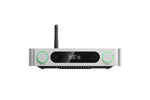
Fixed vs Variable DAC Output: Line Out or Preamp Mode?
, ~에 의해 lea li, 8 분 읽기 시간
, ~에 의해 lea li, 8 분 읽기 시간
Choose fixed line output or variable preamp mode safely for an integrated amplifier, power amplifier or active speakers, while avoiding double volume controls.
Use fixed output when a DAC feeds a normal line input on an integrated amplifier or preamplifier. Use variable output, often called preamp mode, when the DAC or streamer must control the level going directly to a power amplifier or active speakers. The critical safety rule is simple: never connect a source directly to a power amplifier until you have confirmed that its output is genuinely volume-controlled, starts at a low level and cannot unexpectedly switch to full output.
A fixed DAC output provides a consistent line-level signal. Changing the DAC’s volume control does not change that output, so the downstream amplifier or preamplifier controls listening volume. This is the conventional arrangement for an integrated amplifier: source into line input, then use the amplifier’s volume knob.
A variable output changes level under control of the DAC, streamer or app. It allows the source component to behave as a basic preamplifier. That can simplify a system with a power amplifier or active monitors, but it also transfers responsibility for mute behavior, startup level and volume range to the source.
The labels are not perfectly consistent. Manufacturers may use line out, fixed, variable, pre out, preamp or adjustable output. Read the manual for the exact output and mode rather than assuming every RCA or balanced connector behaves the same way.
An integrated amplifier already contains a preamplifier stage and a power-amplifier stage. When a DAC connects to a regular AUX, CD or line input, fixed output is normally the simplest choice. You get one master volume control, a predictable signal level and less chance of accidentally leaving one control near maximum while compensating with the other.
Do not connect a line-level DAC to a phono input. A phono input is designed for the much smaller, equalized signal from a turntable cartridge. Feeding it a normal DAC output can overload the input and produce severe distortion.
If you deliberately use variable output into an integrated amplifier, set up a repeatable gain structure. The arrangement can work, but there are now two volume controls. It becomes easier to create inconsistent channel balance at very low analog-knob positions, raise noise by using too little source level, or surprise another user who changes one control.
A power amplifier normally has no everyday volume control. Active speakers may have rear-panel gain trims but still expect an upstream device to manage listening level. In these systems, a DAC or streamer with a specified variable output can serve as the controller.
The FiiO K13 R2R provides line and preamplifier output functions alongside its digital inputs and headphone outputs. That flexibility makes it useful in a desktop or compact two-channel system, but the selected output mode still needs to match the downstream component. Confirm the display or menu setting before turning on a connected power amplifier.

A DAC with selectable line and preamp output can support several systems, but each mode has a different volume-control responsibility.
Before connecting a DAC directly to a power amplifier, verify five points. The analog output must be variable in the selected mode. Hardware volume control should affect that output. The device should remember or safely limit startup volume. Muting and input switching should not create large transients. Firmware updates, factory resets or app reconnection should not silently change the output to fixed level.
Power everything off while making the connection. Set the source volume to minimum, turn on the source first and the power amplifier last, then increase level slowly with a familiar track. Reverse the sequence when shutting down if the manufacturer recommends it. If you cannot confirm the behavior, use a dedicated preamplifier or an integrated amplifier instead of experimenting with connected speakers.
A dedicated preamplifier can also provide analog input switching, balance control, home-theater bypass, a physical mute circuit and a more usable volume range. A DAC preamp is not automatically inferior, but it may not provide all the control functions a complex system needs.
Many DACs change volume in the digital domain before conversion. Reducing digital level reduces the numeric signal amplitude, which theoretically uses fewer available bits. With modern high-resolution processing and normal listening ranges, this may be insignificant compared with room noise and amplifier noise, but very large attenuation can be less desirable.
Analog volume control operates after conversion and has its own engineering tradeoffs, including channel tracking, noise and distortion. You cannot determine performance from the words digital or analog alone. The implementation and the downstream amplifier’s gain matter more.
For practical setup, avoid running the DAC at an extremely low setting into a high-gain amplifier if a lower amplifier gain option is available. A well-matched gain structure gives useful travel on the volume control and keeps background noise low. Do not use positive digital EQ to compensate for an unnecessarily low output setting because boosts reduce headroom.
Balanced XLR or TRS connections can reject noise in suitable equipment and are useful over longer cable runs. RCA is often entirely adequate for short domestic connections. Either connector can carry a fixed or variable signal; the connector type does not define the control mode.
Likewise, a higher maximum output voltage is not automatically better. A downstream input can overload if the source level exceeds its usable range. Check the input sensitivity or maximum input level of the amplifier or active speaker. If the system reaches full power very early on the volume control, reduce gain where the equipment provides a documented option.
The Arylic S50 Pro+ combines streaming, DAC and RCA preamp-output functions, making it a possible control center for a compact system. Its optical or coaxial digital outputs serve a different purpose: when you send digital audio to an external DAC, the final analog volume-control path depends on the selected devices and settings.

Streaming, conversion and volume control can live in one component, but follow the active signal path before choosing a mode.
Two volume controls are not inherently dangerous, but they make operation less predictable. Suppose a variable DAC feeds an integrated amplifier. If the amplifier is turned high and the DAC remains low, selecting another amplifier input may produce an unexpectedly loud result. If the DAC is turned high while the amplifier is low, someone may later raise the amplifier without realizing how much source level is available.
Choose one daily master control. With a normal integrated amplifier, set the DAC to its documented fixed mode and control volume at the amplifier. With a power amplifier, use the DAC’s variable mode and clearly label or lock the configuration if possible. In a shared household, predictable operation is more valuable than a theoretically shorter signal path.
If an integrated amplifier provides a power-amp input or home-theater bypass, that input may bypass its volume control. Treat it like a direct power-amplifier connection. Do not use it until the upstream device is safely controlling level.
A compact power amplifier such as the Fosi Audio ZA3 can fit the second layout when paired with a suitable volume-controlling source. Confirm the intended operating mode and connections for the exact system rather than treating a power amplifier like an integrated amplifier.
If you are comparing NOS and oversampling settings on an R2R DAC, remember that those are conversion-filter choices, not substitutes for the correct output mode. Our NOS versus OS guide explains that separate decision.
Fixed versus variable DAC output is mainly a system-control decision. Fixed line output is usually correct for an integrated amplifier or separate preamplifier. Variable preamp output is appropriate for a direct connection to a power amplifier or active speakers only when the source offers reliable volume control and safe startup behavior. A one-box DAC preamp can be elegant, but a dedicated preamplifier remains worthwhile when you need analog inputs, robust switching, balance functions or simpler shared use. The best setting is the one that gives the system one clear master volume control and no path to an unexpected full-level signal.