
FiiO AIR AMP Review: Better Than a WiiM Amp Ultra?
, by EMiUZEK Editorial Team, 6 min reading time
, by EMiUZEK Editorial Team, 6 min reading time
A practical FiiO AIR AMP review covering real output power, inputs, streaming, PEQ, speaker matching and how it compares with WiiM Amp Ultra.
The FiiO AIR AMP is a compact streaming amplifier for buyers who want more power and source flexibility than a basic entry-level amp, without building a stack of separate components. With the included 48V/5A supply it is rated at 120W per channel into 4 ohms and 90W per channel into 8 ohms at below 1% THD+N. It combines Wi-Fi streaming, AirPlay, Roon Ready support, USB audio, optical, coaxial, Bluetooth and analog RCA input with speaker and subwoofer outputs. Its main limitation is equally clear: there is no HDMI ARC, so television-first systems may be better served by an alternative such as WiiM Amp Ultra.

AIR AMP is most convincing when you need a small, powerful stereo hub for passive speakers. It accepts a wider range of traditional hi-fi sources than many lifestyle streaming amplifiers: USB-C can turn it into a computer DAC, optical and coaxial support digital transports, RCA accepts an analog source, and USB storage or a network library can provide local playback. Gigabit Ethernet and dual-band Wi-Fi cover network installations, while Bluetooth 5.2 supports SBC and LDAC.
Choose it for a desk, bookshelf system or music-focused living room where HDMI is not essential. Look elsewhere if the television is the primary source, you need multichannel surround processing, or you expect every streaming service to have its own native Connect implementation.
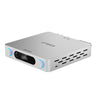
FiiO uses an X2000 system controller, XMOS XU316 USB interface, ES9020Q DAC and TI TPA3255 Class-D power stage. The architecture is designed to place streaming, decoding and amplification in one enclosure measuring roughly 207 × 188 × 42 mm. The unit includes a 1.1-inch display, two front knobs, an infrared remote and app control through FiiO Control.
Those parts do not automatically guarantee better sound than another amplifier. The practical advantages are input coverage, useful power, a dedicated subwoofer output and adjustable processing. Speaker sensitivity, listening distance and room size will matter more than the DAC model printed in a specification table.
With the supplied 48V/5A adapter, FiiO specifies at least 120W + 120W into 4 ohms and 90W + 90W into 8 ohms at less than 1% THD+N. That is enough for many passive bookshelf speakers and moderately demanding floorstanders in small or medium rooms. Buyers should not treat the larger 235W figure sometimes quoted online as directly comparable: it requires an optional 48V/10A supply and is measured at 10% distortion. At the more useful below-1% threshold, the optional supply is rated at 155W + 155W into 4 ohms.
Use 4–8 ohm speakers and leave ventilation around the chassis. If your speakers have unusually low impedance, very low sensitivity or are used at cinema-like levels in a large room, a separate high-current power amplifier may still be the safer choice.
AIR AMP supports AirPlay, QPlay and Roon Ready operation, as well as playback from a NAS, USB drive or portable hard drive through the FiiO Control ecosystem. Streaming and local playback support up to 384kHz/32-bit PCM and DSD256 according to FiiO. USB DAC mode reaches up to 768kHz/32-bit and native DSD512, although the availability of music at those rates should not be a purchase priority.
The more useful feature is 10-band parametric EQ. FiiO provides presets, custom curves and Auto EQ support through the mobile app and web interface. PEQ can correct a headphone-style target only indirectly in a loudspeaker system; for speakers, start with placement and subwoofer integration, then use modest filters to address measured room problems rather than applying large boosts blindly.
The input set includes USB-C audio, USB-A storage, optical, coaxial, RCA line input, Bluetooth and network streaming. Outputs include passive-speaker terminals, a dedicated RCA subwoofer output and a 3.5 mm line output. There is no headphone output, and the line output is not a balanced XLR connection.
The most important omission is HDMI ARC. You can connect a TV through optical, but power synchronization and volume behavior will depend on the television and remote setup. Buyers building a TV-centered stereo should compare the WiiM Amp Ultra, which adds HDMI ARC and a larger touchscreen but costs considerably more.

| Decision point | FiiO AIR AMP | WiiM Amp Ultra |
|---|---|---|
| Included-supply power | 120W/ch at 4Ω; 90W/ch at 8Ω | Higher-power flagship WiiM platform |
| TV connection | Optical; no HDMI ARC | HDMI ARC |
| USB computer audio | USB-C DAC input | USB audio support |
| Room tools | 10-band PEQ and Auto EQ | RoomFit and PEQ |
| Streaming emphasis | AirPlay, QPlay, Roon Ready, NAS and USB storage | WiiM Home ecosystem and broad service integration |
| Current EMIUZEK price | US$239 | US$549 |
AIR AMP is the value and source-flexibility choice. WiiM Amp Ultra is easier to recommend for a television-centered room, buyers who want automated room correction, or households already standardized on WiiM. Neither is automatically superior: the right choice depends on the sources and control experience you will actually use.
Buy AIR AMP if you own passive speakers, need substantial stereo power, want USB and traditional digital inputs, or play local files from a NAS or USB drive. It is especially attractive for music-first systems where an optical TV connection is sufficient and where the US$239 price leaves more budget for speakers.
Do not buy it as a replacement for an AV receiver if you require surround channels, Dolby decoding or multiple HDMI sources. It is also unnecessary if you already own a capable streamer, DAC and power amplifier that meet your needs. In that case, replacing working components may add convenience without producing a meaningful audible improvement.
FiiO AIR AMP delivers an unusually complete music-focused feature set for its price: real speaker power, USB DAC operation, local and network playback, AirPlay, Roon Ready support, LDAC Bluetooth, PEQ and a subwoofer output. Its limitations are not hidden—a lack of HDMI ARC, no multichannel processing and no headphone jack—but those omissions make sense in the right system.
If that system matches yours, see the FiiO AIR AMP product page and the broader streaming amplifier collection. For more context, read our stereo TV checklist and WiiM Amp Pro vs Amp Ultra comparison.